The Turbo Greenland Inverter AC: Is This The Best Boondocking Air Conditioner For RVs?
 Full-Time RV Living: An Honest Review After Real-World Testing
If you’re researching how to run air conditioning while boondocking without draining your batteries or investing in a massive solar system, you’re in the right place. After four years of full-time RV living and over 200 days of serious off-grid camping, we’ve finally found an AC solution that actually makes sense for boondockers.
Why We Needed Something Different
Let’s be real – running traditional RV air conditioners off battery power has always been impractical. Sure, you could do it with 2000+ amp hours of lithium batteries, dual inverters, and your entire roof covered in solar panels. But who can afford that? And even then, you’d probably have panels sitting on the ground like some kind of solar farm.
That’s why inverter technology is such a game-changer for the boondocking community. Finally, we have AC units specifically designed to run efficiently off battery power without requiring you to take out a second mortgage.
Full disclosure: Turbo sent us this unit free of charge for review. However, they don’t see this content before you do, and all opinions are 100% our own. We’re giving you the unfiltered truth about what this unit can and can’t do.
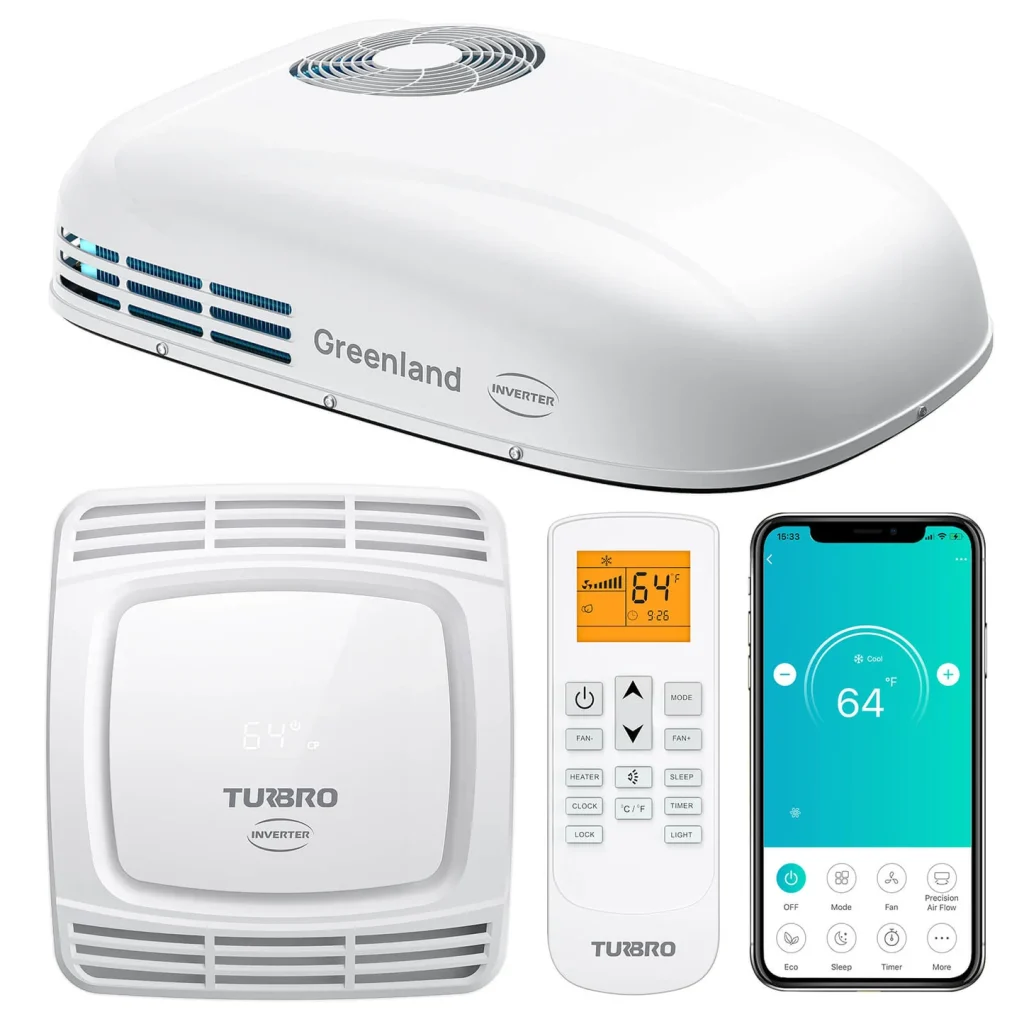 What Makes The Turbo Greenland Different?
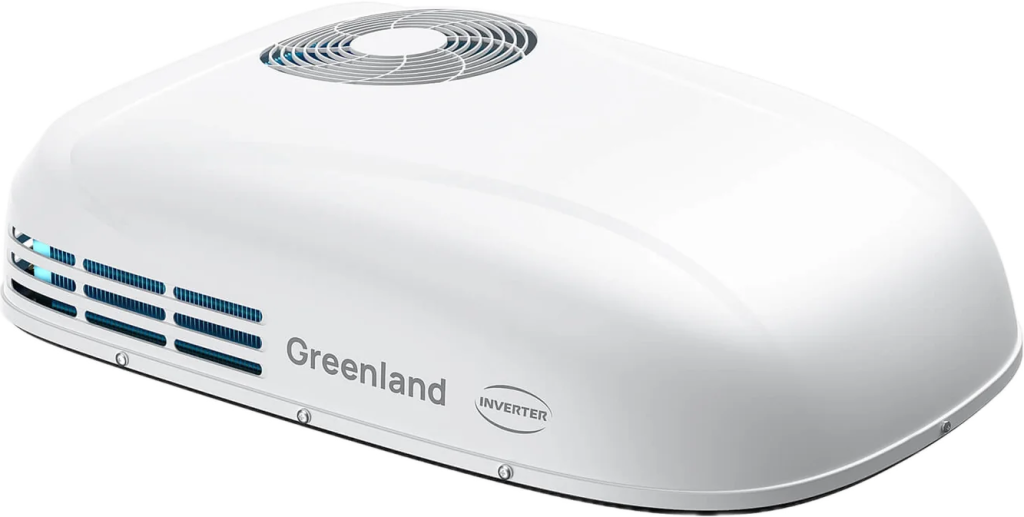
The Technology Behind It
Think of traditional AC units like constantly slamming on the gas and coasting – it’s incredibly inefficient. The Turbo Greenland uses inverter technology, which is more like cruise control. It gradually ramps up and down, using only the power it needs at any given moment.
This technology comes from Turbo’s background as a mini-split manufacturer. They’ve essentially taken their proven mini-split technology and packaged it into an RV rooftop unit. Smart move.
The Stats That Matter
Basic Specifications:
- BTU Rating: 13,500 BTU (13.5K)
- Power Type: 115V Inverter Rooftop
- Running Wattage: 470-750W (typically stays around 470-500W)
- Startup Spike: Virtually none – no soft start required
- Heat Pump: Yes (included)
- Weight: 88 lbs
- MSRP: $1,499
Special Offer: Get 15% off by using this link.
Real-World Performance Testing
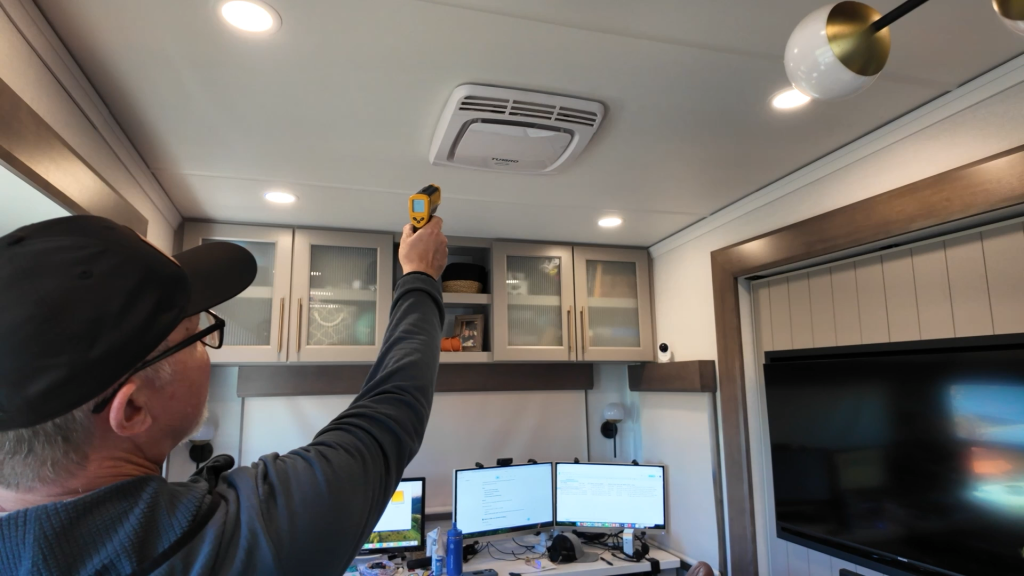 Power Consumption: The Numbers Don’t Lie
We ran side-by-side comparisons between our old Coleman Mach and the Turbo Greenland, monitoring everything through our Blue Eddie inverter panel.
Coleman Mach Results:
- Startup spike: Jumped to 1,300 watts
- Running draw: 766 watts continuous
- Cooling temperature: 56°F coming out of vents
Turbo Greenland Results:
- Startup: Smoothly ramped to 575 watts max
- Running draw: 470-483 watts (stayed remarkably consistent)
- Cooling temperature: 57-59°F coming out of vents
The difference is significant. The Turbo uses roughly 40% less power during operation and has virtually no startup spike. Over a full day of boondocking, that adds up to hours of additional runtime from your batteries.
Noise Levels: The Trade-Off
We measured decibel levels with the unit directly above us:
- High setting: 62-64 dB
- Low setting: Should be quieter, but…
Here’s one of the biggest downsides: the fan speed doesn’t really change much. The unit has a “low” setting, but when we tested it, the noise level barely dropped. This is a real disappointment and something Turbo needs to address.
For comparison, that’s noticeable but not unbearable. It’s about as loud as a normal conversation or background music.
Installation: What You Need To Know
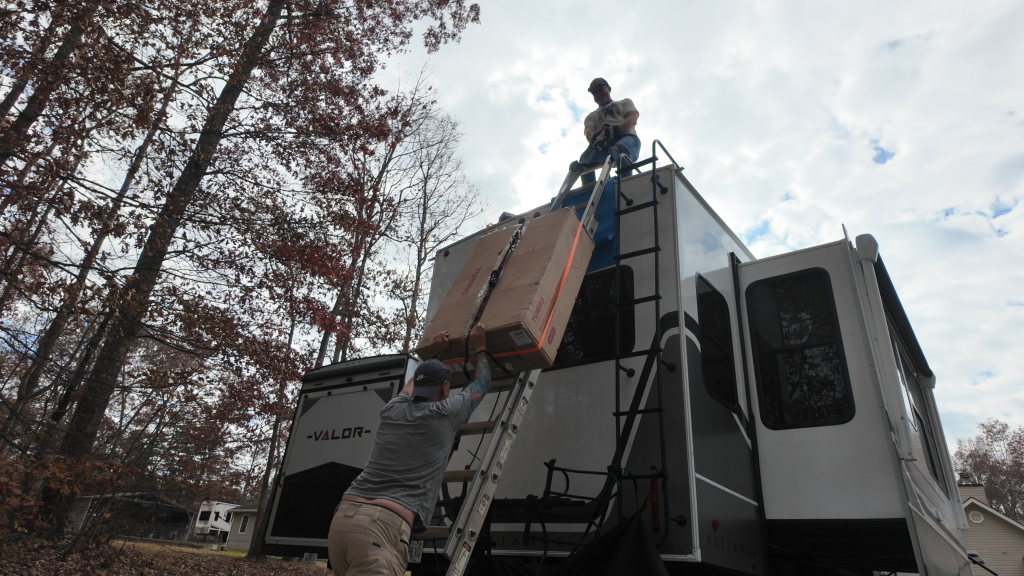 The Process
The installation itself is straightforward – the wiring is clearly labeled and the instructions are easy to follow. We did struggle with one screw that didn’t want to go in, but that was user error, not a problem with the unit.
The Challenge: This unit weighs 88 pounds, and it’s a two-piece system (rooftop unit plus lightweight internal unit). Getting that rooftop unit onto your RV is genuinely a two-person job. We used straps and a ladder, and it took some creative problem-solving.
If you’re not comfortable with this kind of work, budget for professional installation.
The Remote Situation
The Turbo doesn’t work with your existing RV thermostat – it uses its own remote control or a phone app. This is either a minor inconvenience or a dealbreaker, depending on your preference.
Funny story: When we first started using the remote, we discovered it was on the same frequency as our TV remote. Every time we changed the channel, the AC would beep. We had to switch to a different TV remote to solve the problem. Turbo said they’d never heard of this happening before, but it happened to us.
How It Compares To Other Inverter AC Units
We created a comprehensive comparison chart looking at all the major inverter AC options on the market. Here’s what you need to know:
| Model | BTU Rating | Power Type | Running Watt Draw | Startup Spike | Heat Pump | Weight | MSRP |
|---|---|---|---|---|---|---|---|
| Turbro Greenland 13.5K | 13,500 BTU | 115V Inverter Rooftop | ~470–750W | Low / No Spike | Yes | 88 lbs | $1,499 |
| Furrion Chill Cube | 18,000 BTU | 115V Inverter Rooftop | ~1,000–1,200W | Low Spike | No (Cooling Only) | ≈90 lbs | $1,399–$1,499 |
| RecPro / Houghton 13.5K Inverter | 13,500 BTU | 115V Inverter Rooftop | ~1,200–1,500W | Moderate Spike | Yes (Heat Pump) | ≈84 lbs | $1,029–$1,199 |
| Pioneer 13.5K Full Inverter Rooftop | 13,500 BTU | 115V Inverter Rooftop | ~800–1,100W | Low Spike | Yes | ≈90 lbs | $1,528–$1,628 |
| GREE EcoCool 15K | 15,000 BTU | 115V Inverter Rooftop | ~900–1,300W | Low Spike | Yes | ≈100 lbs | $1,395–$1,599 |
| Nomadic Cooling X2 | ~8,000 BTU | 12V / 24V / 48V DC | ~550–700W | No Spike (DC) | No | 44 lbs | $2569-$4115 |
Furrion Chill Cube
This is the closest competitor to the Turbo Greenland – with some key differences:
- 18,000 BTU (vs. 13,500 for Turbo)
- Available in both ducted and non-ducted versions
- Running draw: 1,000-1,200 watts
The Verdict: If you need more cooling power and your RV has ducting, the Furrion might be your choice. But if efficiency is your top priority for boondocking, the Turbo wins hands down.
12V, 24V, and 48V DC Air Conditioners: Not A Valid Alternative for Larger RV’s
We also looked at 12V, 24V, and 48V DC units designed primarily for van lifers and smaller RVs. These units typically range from 6,000-9,500 BTUs and offer some unique advantages – they run directly off your battery bank without needing an inverter, which eliminates conversion losses and can actually be more efficient in certain setups.
The trade-off is lower cooling capacity and the need to run heavy gauge DC cables from your battery bank to wherever you mount the unit. For smaller RVs or those with strategic battery placement, these can be excellent choices. For larger RVs requiring more cooling power, the 115V inverter units like the Turbo tend to be more practical.
The Heat Pump Feature: When To Use It
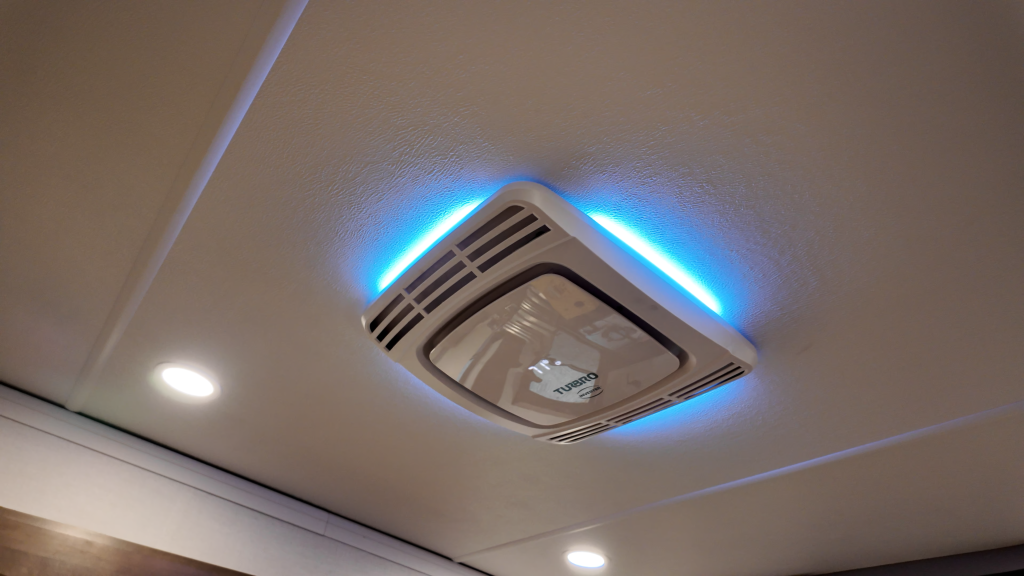 The Turbo includes a heat pump, which is great for specific situations. Here’s when it makes sense:
Good Use Cases:
- When you’re at a full-hookup campground and want to conserve propane
- Running alongside an electric space heater to maximize shore power usage
- Mild weather where you need just a little heat
When NOT To Use It:
- Boondocking (uses too much battery power)
- Seriously cold weather (propane is more efficient)
We measured the heat pump’s performance, and it works well, starting quietly and gradually ramping up. But remember – any form of electric heat will drain batteries quickly. Stick with propane when you’re off-grid.
Who Should Buy This Unit?
Perfect For:
- Serious boondockers who want AC without massive solar/battery systems
- Full-timers with moderate battery banks (we run 800Ah with 1,600W solar)
- Anyone tired of running generators constantly
- RVers in locations where nights cool down but days get warm
- Anyone replacing a non-ducted AC unit
Not Right For:
- RVs that require ducted AC systems (Turbo only comes non-ducted)
- People who absolutely need the quietest possible AC
- Anyone looking for the coldest, most powerful AC
- Those who want precise fan speed control
Our Solar and Battery Setup
People always ask: “How much solar and battery do I need?”
The honest answer is: it depends on how you RV.
Our Setup:
- 800 amp hours of lithium batteries
- 1,600 watts of solar on the roof
- 400 watts powering DC separately
This handles the Turbo Greenland with room to spare. But here’s our philosophy: we don’t believe you need to run AC constantly while boondocking. If it gets too hot, we move to higher elevation or a cooler location. That’s the beauty of having your home on wheels.
If you plan to stay in one spot during hot weather and run AC extensively, you’ll need more capacity. But if you’re flexible and strategic about your locations (like we are), a moderate system works great.
Common Questions Answered
Where Does The Condensation Go?
Just like any rooftop AC, condensation evaporates onto the condenser coil and drains off the roof pan. Water drips onto your roof naturally – exactly how your current AC works.
Will It Run On A Generator?
Yes, any 2,000-watt or larger generator will run this unit without a soft start. If you have a tiny generator under 2,000 watts, you might have issues.
Can It Cool An Entire 40-Foot RV?
No. You can’t do that with a single unit of any kind – that’s why big RVs have multiple AC units. The Turbo is a 13,500 BTU unit, and remember, it only comes in non-ducted format, so it dumps air directly into one area.
Is It Worth The Price?
At $1,499 MSRP (and 15% off with our link), this is competitively priced with other inverter AC units. But here’s what matters: you DON’T need a $300 soft start, and you can run it on a much smaller battery/solar system than traditional units require.
When you factor in those savings, the Turbo actually becomes more affordable than trying to run a traditional AC off batteries.
The Bottom Line
 The Turbo Greenland isn’t perfect – the fan speed control is disappointing, and it’s not the quietest unit on the market. But for what it’s designed to do – provide efficient air conditioning for boondockers without destroying your battery bank – it absolutely delivers.
After four years of full-time RV living, we’ve learned that you don’t need every bell and whistle. You need equipment that does its job reliably without breaking the bank or requiring massive infrastructure.
The Turbo Greenland excels at:
- Minimal power consumption (470-500W running)
- No startup spike (no soft start needed)
- Running on moderate battery/solar systems
- Providing genuine cooling without generator dependency
It falls short on:
- Fan speed control
- Noise levels (though not terrible)
- Ducted options (doesn’t exist)
For serious boondockers who want AC without the insane cost of massive solar and battery systems, this is currently the best option on the market.
Ready To Upgrade Your RV AC?
Get 15% off the Turbo Greenland by using our affiliate link:
www.turbro.com/LIKETHERESNOTOMORROW
Watch Our Complete Video Review
We documented everything in our full video review, including installation footage, side-by-side power comparisons, sound testing, and heat pump demonstrations.
Watch the full review on YouTube

Need Help Planning Your Full-Time RV Journey?
 Wondering how to set up your entire electrical system for boondocking? Confused about battery banks, solar panels, and inverters?
Our comprehensive Full-Time RV Living Course covers everything you need to know, including detailed modules on:
- RV electrical systems and upgrades
- Solar and battery system planning
- Boondocking strategies and locations
- Budgeting for full-time RV life
- And so much more…
Special Launch Pricing Available Now
Plus get one month FREE in our private Facebook community where you can ask us anything!

About Barry & Darlene
We’re Barry and Darlene Nicholson, and we’ve been living full-time in our RV for over four years. After leaving our comfortable life in Florida, we’ve spent over 200 days boondocking, visited incredible locations across the country, and learned what really works (and what doesn’t) when it comes to RV life.
Our mission is to help aspiring full-timers avoid the expensive mistakes we made and create the freedom lifestyle they’re dreaming of. No fluff, no BS – just honest, practical guidance from people who are actually living this life every single day.
Connect With Us:
- YouTube: @liketheresnotomorrow
- Facebook: /liketheresnotomorrow2022
- Instagram: @_liketheresnotomorrow
Product Recommendations & Resources
🛒 RV Gear We Use and LOVE: Amazon Storefront
💚 Our preferred Tank Treatment: Liquified – Bundle Savings Available
🛏️ Get 30% OFF RV Mattress by Brooklyn Bedding – Code: liketheresnotomorrow at checkout
🍷 Harvest Hosts – Unique stays at wineries, farms & museums. Get 20% off with code LIKETHERES20 – Learn More
🔧 etrailer.com – One-stop shop for RV parts with amazing installation videos – Shop Now
🔋 Redodo Lithium Batteries – Get 6% off with code LIKE at checkout
📍 RV LIFE / RV Trip Wizard – Save 25% on trip planning – Activate Discount
Transparency Note: Some links above are affiliate links. We may receive compensation for products covered, which helps us create more helpful content at no extra cost to you. We only recommend products we genuinely use and believe in.
Like There’s No Tomorrow: All Rights Reserved
This content is for entertainment purposes only. We are not RV experts. Always do your own research and make informed decisions for your specific situation.