Free RV camping isn’t gone. But the easy spots everyone relies on are disappearing fast — and we found the government documents to prove it.
If you’ve been RVing for any length of time, you’ve probably felt something shifting.
That spot you camped at two years ago? There’s a sign there now.
That pullout near the park you always used? Gated.
That forest road you bookmarked on iOverlander? Closed marker.
We decided to stop guessing and actually dig into it. Not just “it feels like things are changing” — but finding the actual government documents. The official BLM proposals. The Forest Service orders. The real policy changes that are quietly reshaping where RVers can and can’t go.
What we found was eye-opening. And we put it all in our latest video.
First — This Isn’t a Rant
Before we get into the specifics, let’s be clear about what this is and isn’t.
This is not a “the government is out to get us” story. It’s not political. And it’s not doom and gloom.
The agencies managing this land aren’t making these changes arbitrarily. They spell out their reasons right in the documents — human waste issues, trash, wildfire risk, vegetation damage, and an unprecedented surge in the number of people using public land. Those are real problems with real consequences for the land we all love.
But understanding why it’s happening doesn’t make it any less real for the RVers who show up and find their favorite spots gone.
The honest story is this: free camping isn’t disappearing everywhere. But the easy, convenient, plug-and-play spots near the parks, near the towns, and along the paved roads — those are getting squeezed. And the pace is accelerating.
 The Numbers Behind the Squeeze
To understand why land managers are responding the way they are, you have to look at the demand side of the equation.
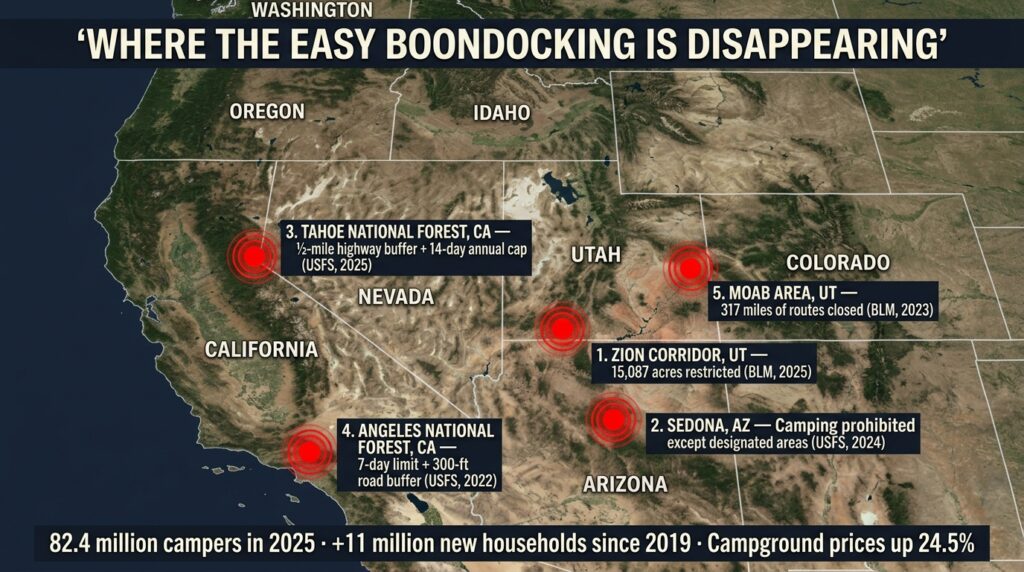
KOA’s 2024 Camping Report shows there are 11 million more camping households today than there were in 2019. The Dyrt’s 2025 Report puts the number of campers at 82.4 million — and more than half of them say they had difficulty booking because campgrounds were full. Campground prices have increased nearly 25% since 2018, which means more and more people are turning to free BLM and National Forest land as their primary option.
More people on the same land means more pressure. More pressure means land managers have to respond. And they are — consistently, repeatedly, and in ways that directly affect how and where RVers can camp.
The Proof — What the Documents Actually Say
This is the section most people never see. Because these orders are publicly available — they’re not hidden — but they don’t show up in your app. They don’t send you a notification. You find out about them when you arrive.
Here’s what we found.
Zion SR-9 Corridor — 15,087 Acres Restricted
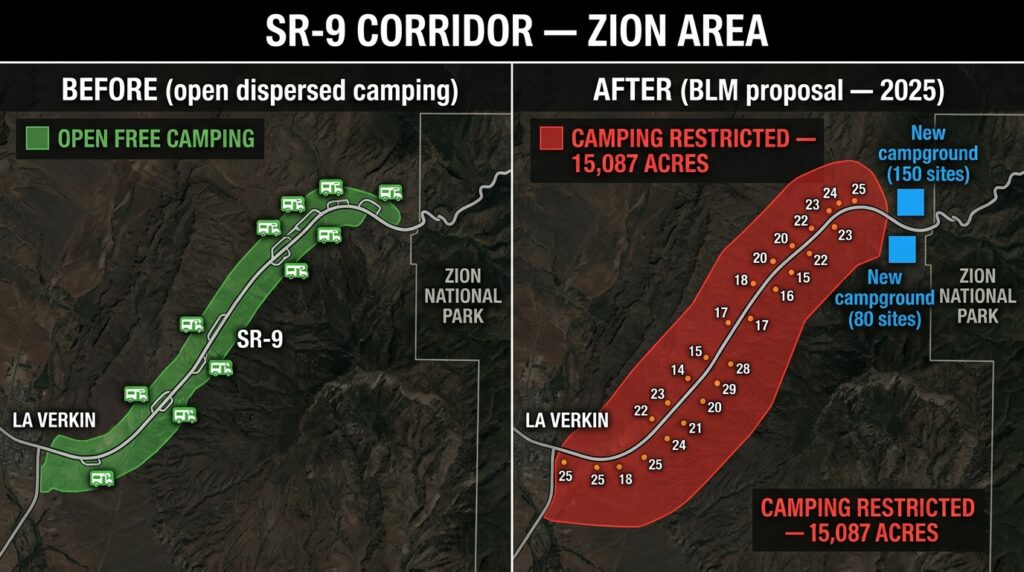 If you’ve ever camped near Zion National Park in Utah, you know the SR-9 corridor. The road that runs west from Zion toward the town of La Verkin. For years it was one of the most popular boondocking areas in the entire country. RVers would pull off along that road, park for free, wake up with incredible views.
In May 2025 the BLM released a proposal to change all of that — and it has since been approved and is now being implemented. You can read the official BLM announcement here.
The restriction covers 15,087 acres. That’s not a small pullout. That’s a corridor. Of all the dispersed camping spots that existed there, 30 are being removed and only 25 designated sites are remaining. In their place, two new managed campgrounds are being built with a combined 230 sites — fee campgrounds, reservable, managed. A completely different experience than boondocking. And not free.
Here’s the part that really stings: those campgrounds are contingent on future funding. The agency doesn’t even have the money to build them yet. But the 15,000 acres? Already restricted. The BlueRibbon Coalition has been tracking this closely and their coverage is worth reading for the full picture.
West Sedona — Camping Prohibited
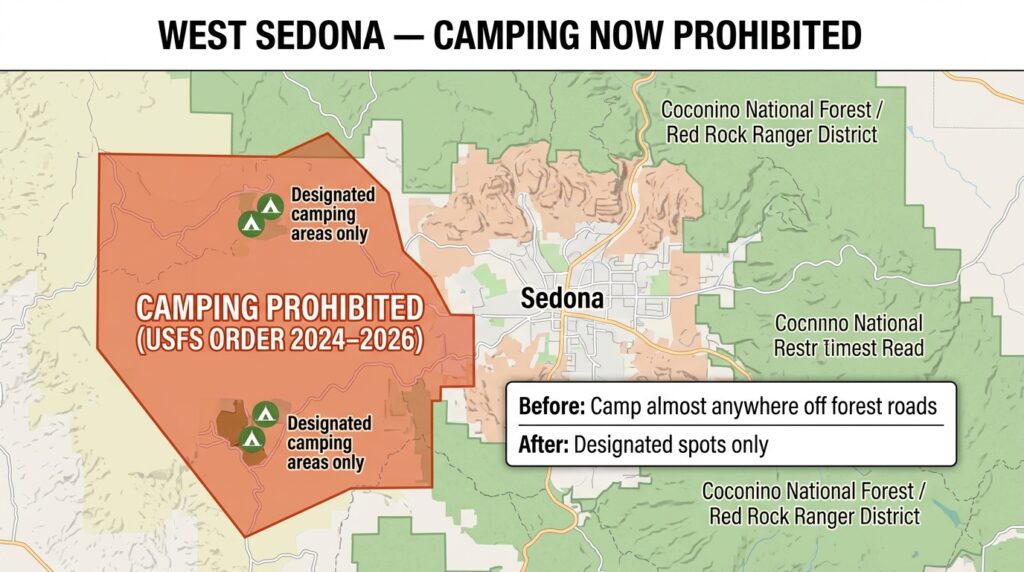 In August 2024 the Forest Service issued an order for the West Sedona area that is about as blunt as it gets. You can read the full official order on the USFS website here.
The language reads: “Camping prohibited in the described area except within designated camping areas.”
Not restricted. Not limited. Prohibited. The forest roads that people used to find their own spots on — gone. The order runs through August 2026 and based on the pattern we’re seeing everywhere else, it will almost certainly be renewed. If you want to see what designated camping currently looks like in the Sedona area, the USFS West Sedona Designated Dispersed Camping page shows the eight areas that remain available.
Tahoe National Forest — The Double Punch
 This one is especially important for full-timers because it exposes a rule most RVers genuinely don’t know about.
Most of us know the 14-day rule. You stay 14 days, you move at least 25 miles, you find another spot. That’s the assumption most boondockers operate on.
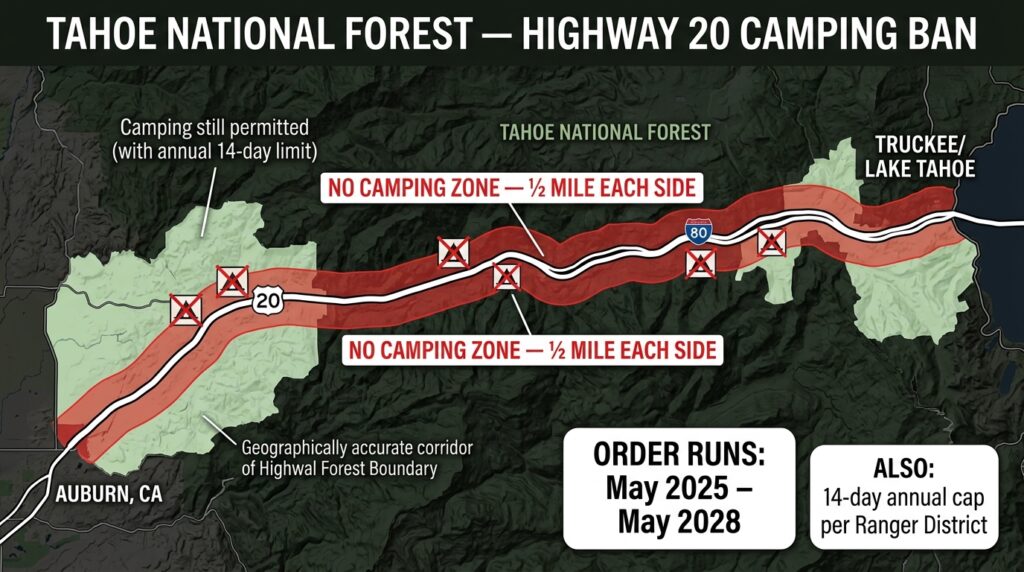
In Tahoe National Forest that rule changed. In April 2024 they issued an order limiting dispersed camping to 14 days per calendar year per ranger district. Not 14 days per stay. Fourteen days total for the whole year. You can read the official Tahoe NF Annual Occupancy Order here.
If you’ve been bouncing around the Tahoe area all summer thinking you’re legal — you may not be.
Then in May 2025 they added another layer. The Highway 20 corridor — the road that runs alongside I-80 through the Tahoe forest — now prohibits camping within a half mile of the highway on both sides. For three years. The official Highway 20 Corridor Camping Restriction order is here. The convenient pull-offs that people used on their way to Tahoe are gone. The annual cap squeezes you from one direction, the corridor ban squeezes you from the other. That’s what we called the double punch.
Angeles National Forest — The 300-Foot Rule
Angeles National Forest serves twenty million people’s backyard. Their rules have been in place since December 2022 and run through 2026.
Seven consecutive days maximum outside of developed campgrounds. No camping within 300 feet of any road. An annual cap on total camping days. You can check current orders and alerts directly on the Angeles National Forest alerts page.
That 300-foot rule is more significant than it sounds. Think about where boondocking spots actually are. Most of them are near roads — that’s how you get to them. The 300-foot buffer eliminates the majority of places people actually use.
The Vocabulary Shift Nobody Is Talking About
Here’s something subtle but important. The language is changing — and it matters.
Land managers still use the term “dispersed camping.” So when you read that dispersed camping is still available in an area, it’s technically true. But what that term means now is very different from what it used to mean.
Old meaning of dispersed camping: Drive a road. Find a pullout. Camp. Unlimited options.
New meaning of dispersed camping: Numbered posts. Fire rings. Fixed inventory. First-come-first-served. Often single-digit availability.
The BLM Hurricane Cliffs area near St. George — one of our most memorable boondocking experiences — is now 56 designated sites with numbered posts. The Quail Creek area nearby has 8 sites. Some of those sites have a one-night maximum — even though it’s free.
So yes, dispersed camping still exists. But you need to understand what they mean by it now.
What RVers Are Experiencing on the Ground
You don’t have to take our word for it. Go into the RV forums, Reddit, and the camping apps and you’ll find people documenting this in real time.
iOverlander listings showing “closed January 2025 — new signage at all entrances.” Campendium posts reporting “designated only now, red posts, almost always taken.” Facebook group members flagging that spots they’ve visited for years have changed rules, new gates, or new signs.
The sentiment that keeps coming up over and over is simple: anything free and easy gets ruined. Which is kind of the whole story. The places that were easy and free attracted so many people that they couldn’t stay easy and free.
We’ve experienced this ourselves. Places we camped three or four years ago that just don’t exist the same way anymore.
Is Your Favorite Boondocking Spot Still Open?
 This is the practical question every RVer needs to answer before their next trip. And the honest answer is — you can’t assume anymore.
Here’s a quick pre-trip checklist that takes about 15 minutes and can save you a very frustrating arrival.
Check the BLM field office website. Go to blm.gov and navigate to the specific field office managing your area. Look for active orders, current stay limits, and any designated-only notices. Rules are issued at the field office level so a restriction in one office may not apply twenty miles away in the next one.
Check the USFS ranger district website if you’re on forest land. Go to fs.usda.gov and find the specific ranger district. Look for Special Orders and Closure Orders. Also verify your planned road is on the Motor Vehicle Use Map as open to vehicles.
Cross-reference on iOverlander and Campendium. iOverlander and Campendium won’t replace the official sources but they give you real-time ground truth from other RVers. Always sort by most recent — a great review from 2021 tells you nothing about 2026.
Check relevant Facebook Groups. Groups like Boondocking for Big Rigs often have the most current on-the-ground reports. Search for your specific area before you go.
Always have a spot A, B, and C. Even after all the research, things change. Never arrive anywhere with only one option. We use iOverlander, Campendium, and Google Earth together to identify and vet multiple backup spots before every trip.
Where Boondocking Still Works
Let’s be clear about something important. The BLM manages 245 million acres. The National Forest system manages another 193 million. There is still an enormous amount of public land available for dispersed camping.
The restrictions we’ve covered are real — but they’re concentrated in hotspots. Near the big national parks. Near towns. Along highways. Go 30, 40, 50 miles from the popular areas and things open up considerably. The land is still there. The access is still there. It just requires more planning and a little more drive time.
The LTVAs in Arizona are still a fantastic option — Long-Term Visitor Areas where a couple hundred dollars gets you a whole season of BLM camping. Quartzsite, Yuma, the La Posa area. Real boondocking, just managed differently.
And honestly? For the kind of experience most boondockers are after — true isolation, no neighbors, real off-grid living — going a little farther from the popular areas often means a better experience anyway.
The Future of Boondocking
 The shift we’re describing isn’t going away. If anything the pattern suggests it’s accelerating. More designated dispersed systems. More corridor buffers. More annual caps. Potentially reservation systems for dispersed areas that are currently first-come-first-served.
Boondocking itself is not going away. But the way we do it is changing. The planning involved is more. The flexibility required is more. And the people who adapt — who do the research, camp farther out, and take care of the spots they find — are going to have dramatically better experiences than those who rely on old information and old assumptions.
The spots that get trashed become the next restriction. That’s not a lecture — that’s just the math playing out in real time across public lands all over the country.
Watch the Full Video
We cover all of this in detail in our latest YouTube video — including showing the actual government documents on screen, the specific numbers from each order, and exactly what the shift from “camp anywhere” to “camp here only” looks like in practice.
👉 Watch: They’re Closing the Best Boondocking Spots — Here’s the Proof
If this is something you’ve been feeling on your travels, drop a comment on the video. We’d genuinely love to know where you’ve seen it happening. This is an ongoing story and your experiences help the whole community stay informed.
Barry and Darlene have been living full-time in their RV since 2022. Like There’s No Tomorrow documents the real, unfiltered experience of full-time RV life — the good, the challenging, and everything in between. Subscribe on YouTube for new videos every week.