(Video 2 is embedded at the top of this page.)
If you’re just finding this story, here’s the quick version: while we were parked and getting ready to leave, we heard a loud boom under our fifth wheel. We ran outside and saw questionable liquid pouring from underneath the RV… and then realized the unthinkable:
One of our RV holding tanks had completely fallen out of the underbelly and onto the ground.
That’s not a sentence you ever expect to say, especially with a newer rig. And yes — this was our kitchen gray tank, and yes — it was shocking, stressful, and absolutely not something that should ever happen.
Watch Part 1 (The moment it happened)
You can watch the original “tank fell out” video here:
👉 https://youtu.be/B_qKBWdYrVw
The Immediate Problem: Can We Even Move the RV?
After the initial shock, reality hit fast. We weren’t just dealing with an RV tank failure — we had a bigger issue:
Our slides and hydraulic jacks weren’t working, and we had family flying in for Christmas. We were staring at a broken holding tank, liquid under the rig, and a growing list of “we have to leave” problems.
We didn’t even know if the tank systems were independent. In other words: if the gray tank isn’t there… do the other tanks dump safely, or are they connected in a way that creates another mess?
While we tried to think through all of that, we did what most full-timers do in a crisis: take a breath… then start solving one problem at a time.
 The Temporary Fix: Strap It Down and Keep Moving
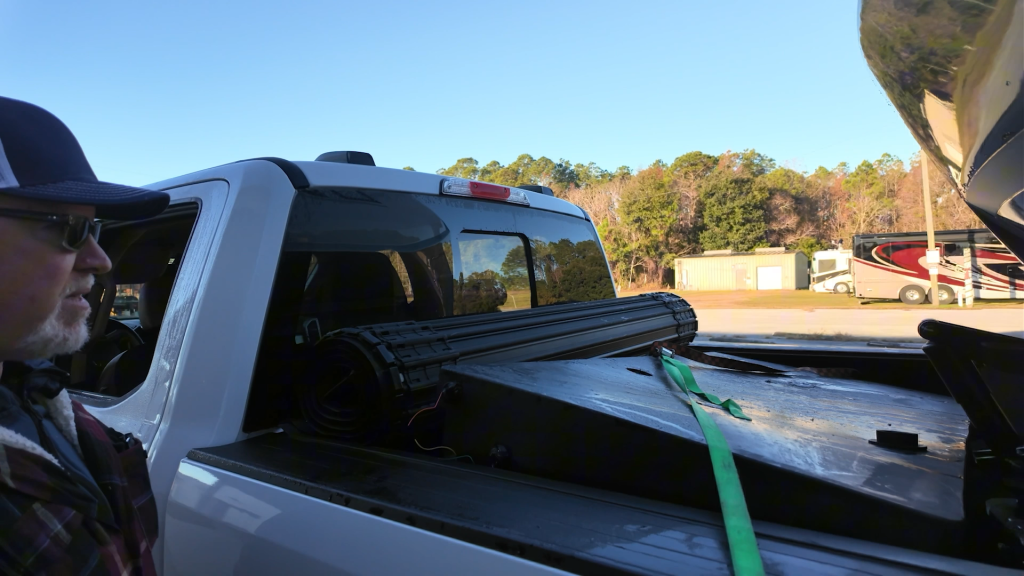
Our first priority was getting the tank secured enough to travel.
We strapped the tank down and pulled it into a temporary “hold it together” setup. We disconnected the tank sensors and even dealt with a small 12-volt tank heater cable underneath. The good news: the tank itself was mostly intact — the tech believed only a small plastic piece cracked when the tank separated and fell.
But our big question was: what failed under the RV — and can it be replaced and reinforced properly?
That’s when we started talking with Alliance.
Alliance Got Involved (And Why That Matters)
We want to be clear: this shouldn’t have happened — and Alliance agrees.
We were in contact with Carter at Alliance early on. They asked for details, wanted information from the tech, and they offered support immediately — even with it being right before Christmas.
For us, this is the part that matters most: not “do problems ever happen,” because RV life guarantees they will… but how the manufacturer responds when they do.
This is our second Alliance RV. Our first Alliance had a few issues too — normal RV stuff — and we chose to stay with Alliance because of customer service, responsiveness, and overall quality. That has been our experience over four years.
 The “Embarrassing Twist”: The Hydraulics Were Our Fault
Here’s where we have to laugh (now)… because in the moment, it definitely wasn’t funny.
The whole hydraulic problem with the jacks and slides? My fault.
It had nothing to do with the tank falling out.
Earlier that week, I was messing with our inverter setup (our BLUETTI RV5 system) and battery wiring. In the process, a cable ended up down behind the battery and we didn’t realize it. So when the tank incident happened, we assumed the RV hydraulics and electrical system had been damaged.
Turns out… we simply didn’t have the battery hooked up correctly.
Yes, I felt like a knucklehead. Because I was one. 😅
But we’re sharing that because it’s real life — and honestly, it’s important for other RVers to hear. Sometimes multiple problems happen at once, and not all of them are connected.
 The Real Repair: What the Tech Found Under the RV
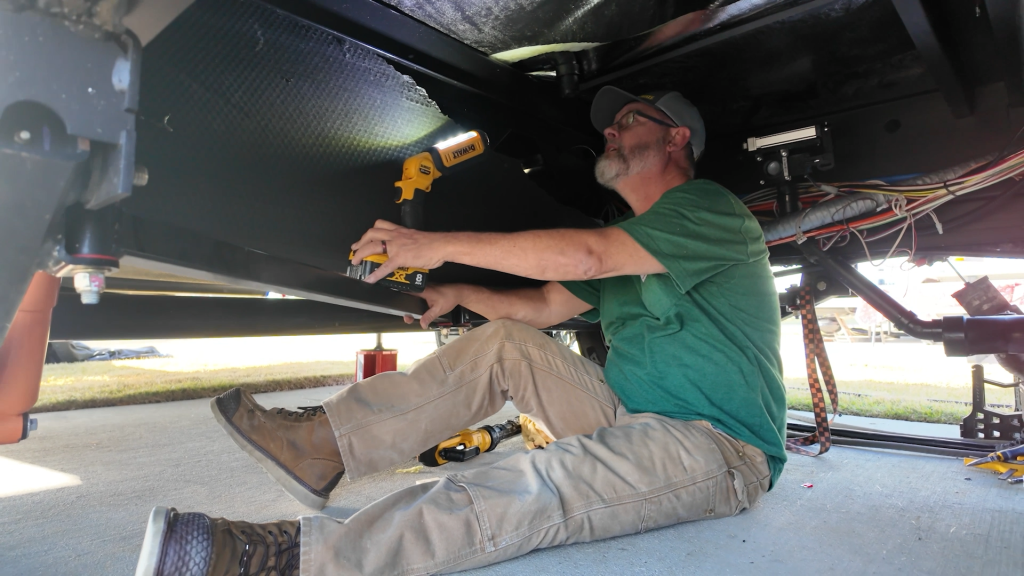
Once we got to our next stop, we met up with a mobile RV tech (shoutout to JT). What he found was actually pretty straightforward:
One side of the tank support is welded into the chassis (it’s solid and doesn’t move).
The other side is a beam that’s installed with heavy-duty self-tapping screws.
On our rig, that beam wasn’t sitting perfectly at 90 degrees — it was slightly slanted.
The working theory is the tank slid off the ledge because of that misalignment, especially if the rig was on a slope.
To fix it, the tech repositioned the beam, redrilled and re-secured it tightly against the tank, and then we added metal strapping underneath as reinforcement (pipe strapping). This gives extra support if the tank ever tries to shift again.
 How Alliance Secures Tanks (And Why We Believe This Was Isolated)
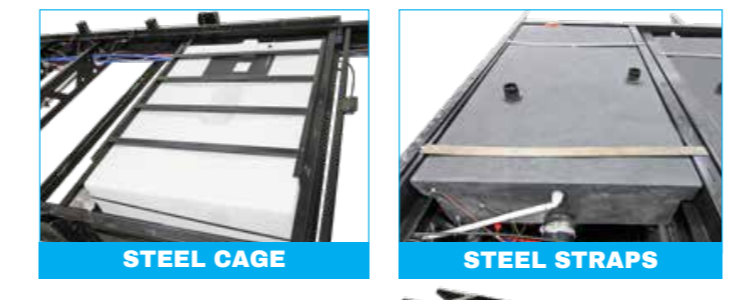
A big question we saw in comments was: “Why aren’t there straps under the tank from the factory?”
Alliance doesn’t secure them that way. Their design uses the beams and straps that tie the structure together from above, and we’ll overlay images/video here showing how the system is designed.
Did it work in our case? Obviously not — because our tank fell out.
But based on what Alliance shared and what we’ve learned, this appears to be an isolated incident, not a systemic pattern or recall situation.
Alliance told us they haven’t had reports like this on the newer coaches, and the only similar issues they were aware of were years back involving fresh tanks in a different product line — not the gray tank setup we had.
 Our Takeaway (And Our Philosophy)
We get why people react strongly. A holding tank falling out could have been catastrophic if it happened on the highway.
But here’s our philosophy as full-time RVers:
We don’t live in outrage.
We don’t spend our time ranting in groups.
We fix what’s broken, learn from it, and get back to living the lifestyle.
RV life is about traveling, exploring, and experiencing new places. The RV is the vessel — not the point.
And yes, we’re still happy. We’re back on the road. And we’re ready for the next adventure.
Watch the full update (Video 2)
(Video 2 is embedded at the top of this page — but if you’re reading this somewhere else, it’s the follow-up titled: “TANK FELL OUT Update: What Really Happened (And How It Was Fixed)”)