GVWR vs GCWR: What RVers Need to Know Before Towing
If you have ever stood at the back of a truck squinting at a yellow door sticker, then walked over to your RV and squinted at another label full of acronyms, you already know the problem. Truck and RV manufacturers print a lot of numbers, and somewhere in the middle of all of it, a salesperson, a forum stranger, or a cousin who once owned a pop-up tells you, "You're fine, that truck can tow it."
Maybe. Maybe not.
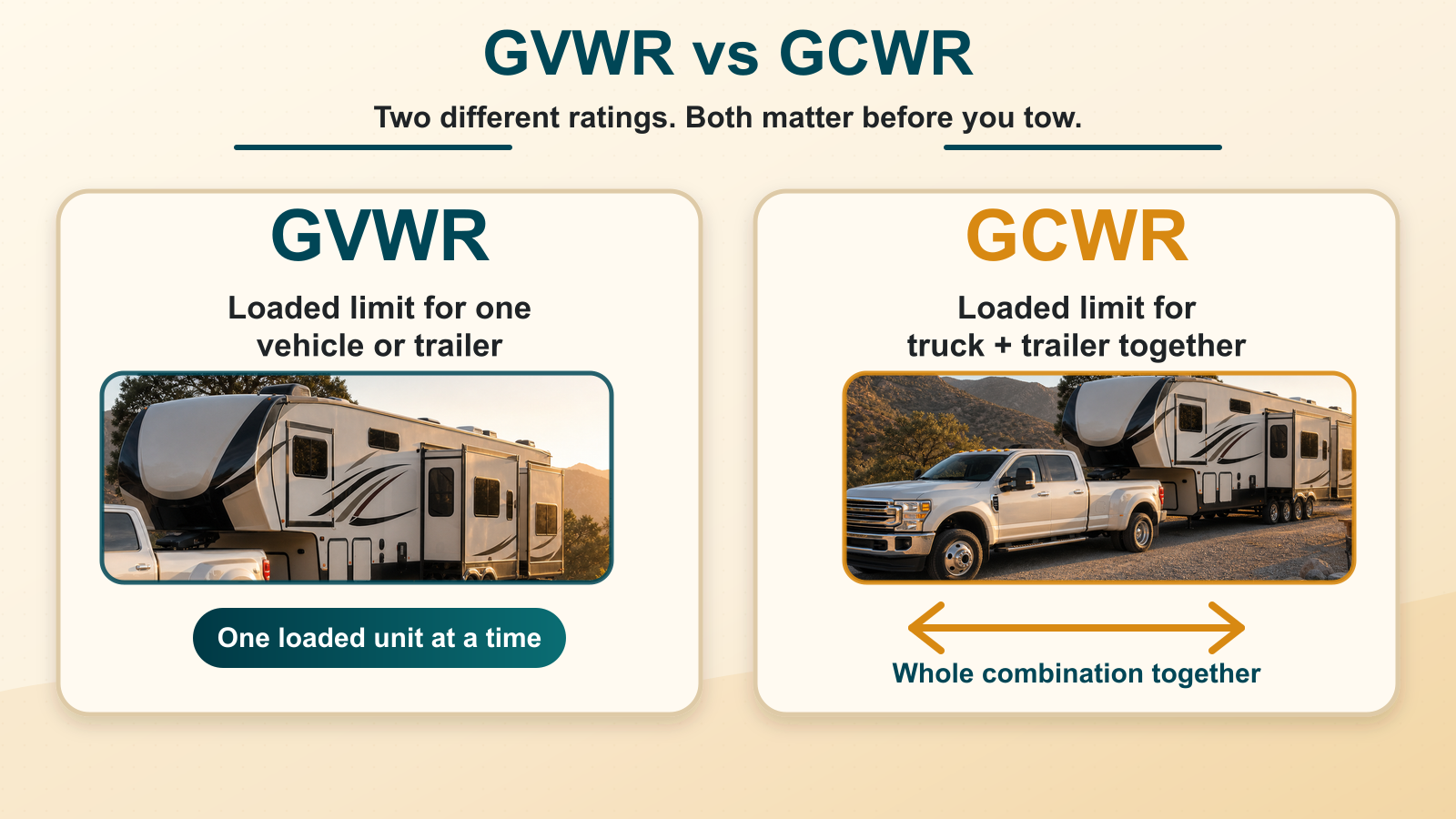
GVWR and GCWR are two of the numbers that actually matter, and they get mixed up constantly. The short version is this: GVWR is the most one vehicle or trailer is rated to weigh when it's loaded. GCWR is the most the truck and trailer together are rated to weigh when they're both loaded. Different jobs. Both important. Neither one tells the whole story by itself.
The part that trips people up is that you can be under GCWR and still be over your truck's payload, your rear axle rating, your tire rating, or your trailer's GVWR. So if someone is pointing at GCWR alone and telling you everything is good, they're looking at one piece of a bigger picture.
Want to run your own setup?
If you already have your truck and RV numbers handy and you'd like to skip ahead and just see whether the math works, the LTNT payload calculator will walk you through it.
Run Your NumbersOtherwise, grab a coffee. Let's go through this the way I'd explain it at the kitchen table.
Why These Ratings Matter Before You Tow
Most towing conversations start and end with tow rating.
"This truck tows 15,000 pounds."
"This fifth wheel is only 12,000 dry."
"You're well under, you're fine."
The trouble is that real towing isn't brochure towing. Real towing includes the people in the cab, the dogs, the hitch, tools in the bed, fuel, water, propane, batteries, food, clothes, camping chairs, the generator, the bikes, and all the stuff that somehow ends up in the RV because "we might need it on the road."
That's why GVWR and GCWR matter. They're not there to scare anyone. They're guardrails the manufacturer set so you can check whether the actual loaded setup makes sense, instead of betting on a marketing number from a brochure.
The goal isn't to find one magic rating and call it a day. It's to look at the whole combination:
- What's the truck rated to weigh?
- What's the trailer rated to weigh?
- What are the truck and trailer rated to weigh together?
- How much is sitting on the truck itself?
- How much is sitting on each axle?
- And what do the actual scale numbers say once everything is loaded for real life?
If you're sorting out the bigger "can my truck handle this RV" question, the place to start is our main pillar: Can My Truck Tow My Fifth Wheel? This article you're reading now is the support piece that sits underneath it and gets into the weeds on GVWR and GCWR specifically.
Watch: The Towing Number Most RVers Miss
Before we get into the definitions, the video below covers the bigger mistake we see all the time — trusting tow rating, missing payload, and ignoring what pin weight actually does to a truck.
What GVWR Actually Means
GVWR stands for Gross Vehicle Weight Rating, and in plain English it's the most a single vehicle or trailer is rated to weigh when it's fully loaded.
For your truck, that means the truck itself plus the people in it, the fuel in the tank, the hitch, anything in the bed, tools, gear, and the tongue weight or pin weight from whatever you're towing. Everything the truck carries counts toward GVWR.
For your RV, GVWR is the maximum loaded weight of the trailer. That includes the RV itself, factory options, dealer add-ons, water, propane, batteries, food, clothes, gear, the rugs you bought because they "really tied the room together," and everything else loaded into it.
This is why dry weight gets people in trouble. Dry weight (sometimes shown as UVW, unloaded vehicle weight) is what the trailer weighed before anybody put anything in it. None of us camp like that. You don't roll into a campsite with no water, no propane, no food, no clothes, and no gear. So if you're trying to plan a towing setup and you don't have actual loaded scale weights yet, trailer GVWR is the safer planning number than dry weight, every time.
You can usually find GVWR on the truck's certification label inside the driver's door jamb, in the truck owner's manual or towing guide, on the federal weight label on the RV, or in the RV owner's manual or spec sheet.
What GCWR Actually Means
GCWR stands for Gross Combined Weight Rating. That's the maximum loaded weight of the truck and trailer together.
Loaded truck plus loaded trailer equals gross combined weight. That number shouldn't exceed the manufacturer's GCWR.
GCWR is genuinely useful because it gives you a ceiling for the whole rig. But here's where I want to slow down, because this is the part that catches RVers: a truck and RV can be comfortably under GCWR and still have a real problem.
You can be under GCWR and over the truck's GVWR. Or over the rear axle rating. Or over your tires. Or over the trailer's GVWR. Or out of payload because of passengers, hitch weight, bed cargo, and pin weight stacking up. GCWR doesn't catch any of that on its own. It just tells you the combined number.
GVWR vs GCWR, the Kitchen-Table Version
If you only remember two questions, make it these:
GVWR asks: how heavy is this one truck or trailer allowed to be?
GCWR asks: how heavy is the whole truck-and-trailer combination allowed to be?
Think of GVWR as the limit for each piece on its own. Think of GCWR as the limit for the whole team.
Both matter. Neither replaces the payload conversation.
A quick example with round numbers, just to show how they fit together:
- Truck GVWR: 11,500 lb
- Truck loaded weight: 11,200 lb
- Trailer GVWR: 16,000 lb
- Trailer loaded weight: 15,000 lb
- Truck GCWR: 30,000 lb
- Combined loaded weight: 26,200 lb
At a glance, that all looks fine. The combined weight is 3,800 pounds under GCWR. But if the truck only had 3,000 pounds of payload to start with, and the pin weight, hitch, passengers, and bed gear added up to more than that, the truck is overloaded even though the GCWR check passes.
This is where the phrase that sticks with me comes in: the limiting number is the one you hit first. It might be GCWR. It might be payload. It might be the rear axle. Whichever rating runs out first is the rating that's actually limiting your setup, no matter what the others say.
The Other Acronyms Worth Knowing
GVWR and GCWR are the headliners of this article, but a few other ratings show up on the same labels and they're worth knowing.
GAWR — Gross Axle Weight Rating. The maximum weight an axle is rated to carry. Your truck has a front and rear GAWR, and your trailer has axle ratings of its own. A rig can be fine on total weight and still be overloaded on a single axle, which is why this one matters on its own.
RAWR — Rear Axle Weight Rating. This is the rear axle limit specifically, and for fifth wheel folks it's a big deal. Pin weight lands in the truck bed, basically right on top of the rear axle. A fifth wheel can run a truck out of rear axle capacity well before it runs out of GCWR.
FAWR — Front Axle Weight Rating. The front axle limit. It comes into play depending on how the load is distributed and how the hitch is set up.
Curb weight. What the truck weighs before you add real-life cargo and passengers. Manufacturers define it slightly differently, but it generally includes the vehicle plus the fluids it needs to operate. The catch is that curb weight is not your camping weight. Nobody travels at curb weight.
Payload. What the truck can carry. This includes passengers, cargo, hitch, bed gear, tools, dogs, fuel — and the trailer's tongue weight or pin weight. For most RV setups, this is where things get tight.
Tow rating. The maximum trailer weight the truck is rated to pull, calculated under the manufacturer's specific test conditions. It varies based on engine, axle ratio, cab, bed length, options, and how the truck is loaded for the test. Useful information. Not the only number you should trust.
How GVWR Connects to Payload
GVWR and payload are joined at the hip.
At the simplest level, truck GVWR minus the truck's actual weight equals what's left over to carry. But the easier place to start for most RVers is the yellow payload sticker on the driver's door jamb. That sticker tells you the combined weight of occupants and cargo for that specific truck as it left the factory.
And then real life starts chipping away at it. The driver, the passengers, the dogs, the fifth wheel hitch or weight distribution hitch, tools, bed cargo, firewood, the generator, the auxiliary fuel tank — all of it counts. And then the big one: the weight your trailer puts on the truck. Tongue weight on a travel trailer, pin weight on a fifth wheel. Either way, it lands on the payload sticker.
That's why a truck can have an impressive tow rating on the brochure and still not have enough payload for the RV someone wants to tow. The payload conversation is where the math actually shakes out, which is also why it's the focus of the main pillar article if you want the broader walk-through.
How GCWR Connects to Tow Rating
GCWR is one of the numbers behind tow rating. The simple version is GCWR minus the loaded truck weight equals how much trailer the truck has left to pull.
The phrase to pay attention to there is loaded truck weight. If the tow rating was calculated with a relatively empty truck, and your real-life truck is hauling two adults, a big hitch, tools, the dog crate, fuel, and a loaded bed, your actual available towing capacity is lower than the brochure number. That's not a flaw in tow rating, it's just how the math works once the truck has its real-world load on it.
So GCWR isn't useless. It's just one check. The full list still includes truck GVWR, payload, rear axle rating, tire ratings, trailer GVWR, the actual loaded trailer weight, and the actual scale weights. If those line up, you're in good shape. If one of them is tight, that's the limiting number.
Fifth Wheels vs Travel Trailers: Why the Ratings Feel Different
Both fifth wheels and travel trailers put weight on the truck, but they put it in different places.
A travel trailer puts tongue weight on the hitch behind the truck. A fifth wheel puts pin weight directly into the truck bed, over or near the rear axle. Either way, the weight counts against payload. But fifth wheels can be sneaky on payload because so much of that weight lands in one spot, right where the rear axle is paying attention.
Plenty of fifth wheel buyers run out of payload or rear axle capacity before they ever come close to GCWR. The combined weight check looks fine, but the truck-side numbers tell a different story.
We'll cover pin weight in detail in a separate support article, because it really does deserve its own breakdown.
A Simple Towing Ratings Workflow
Here's the order I'd actually use when I'm checking a setup, whether I'm shopping for a new RV or making sure an existing rig still pencils out.
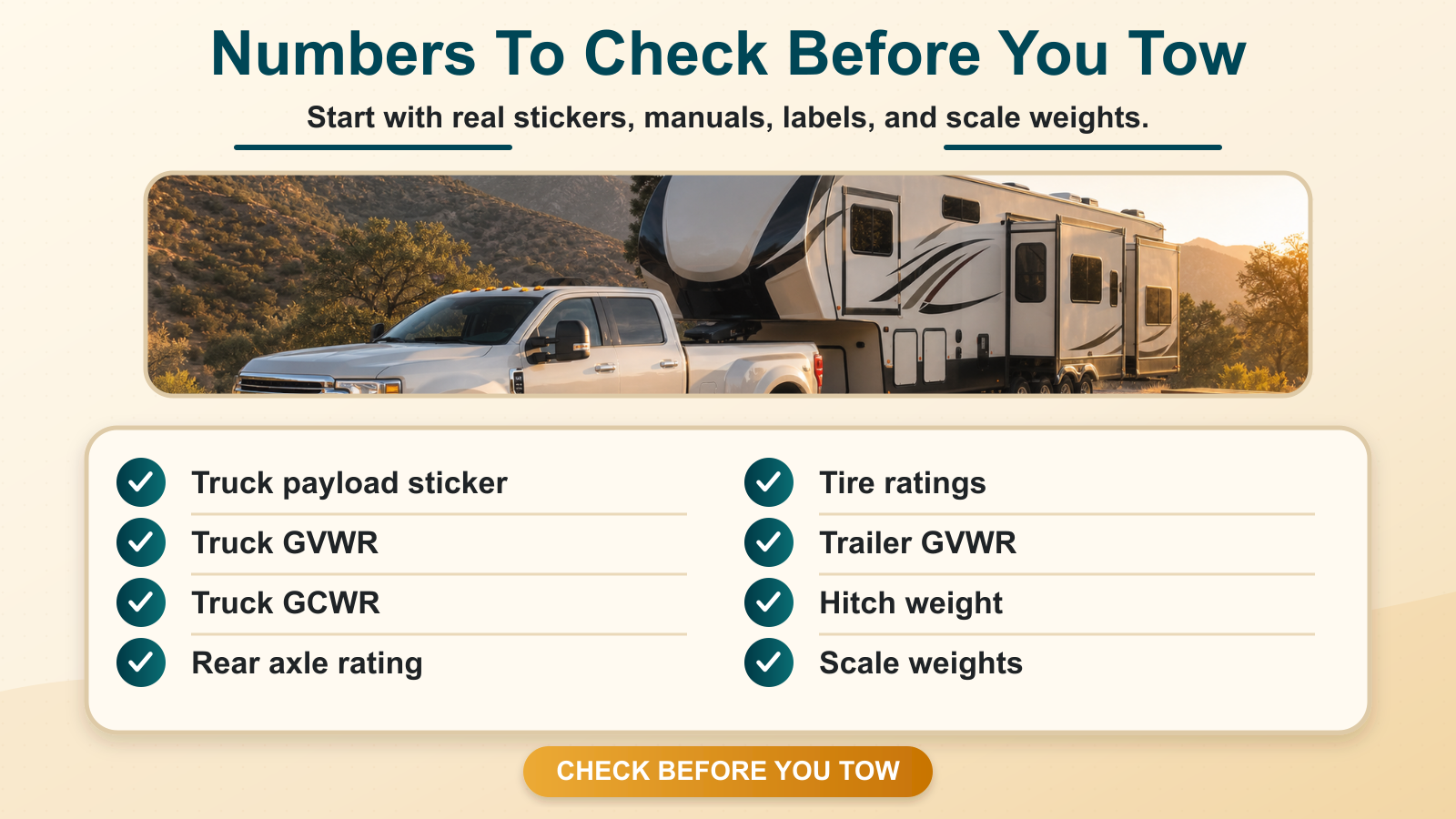
- Find the truck's payload sticker first. Open the driver's door, look at the yellow sticker, and find the line that says the combined weight of occupants and cargo should not exceed X pounds. That's your starting point.
- Pull truck GVWR, GCWR, GAWR, RAWR, and tire ratings. Check the door sticker, certification label, owner's manual, and your truck's specific towing guide. Don't go off the badge on the side of the truck. Two trucks with the same badge can have very different numbers depending on engine, axle ratio, cab, bed, packages, and trim.
- Find trailer GVWR. It's on the federal weight label on the RV. Note UVW or dry weight if you want, but plan around GVWR, not dry weight.
- Estimate loaded tongue or pin weight. For a travel trailer, tongue weight. For a fifth wheel, pin weight. Either way, it counts against the truck.
- Add the rest of the truck's real-world load. Passengers, pets, hitch, tools, bed cargo, generator, fuel, accessories, and anything else that's riding along.
- Run the numbers through the LTNT payload calculator. It won't certify anything as safe or legal, but it will show you whether your loaded setup is asking too much of the truck.
- Verify with scale weights when you can. Planning math gets you most of the way. Actual scale numbers tell you what's really happening.
Check Your Real-World Numbers
The workflow is easier when you can put the truck and trailer numbers in one place. Use the calculator as a planning check, then verify with your stickers, manuals, and scale weights.
When One Number Looks Fine But Another Fails
Here's the kind of example that catches people, and it's the reason I keep harping on the limiting-number idea.
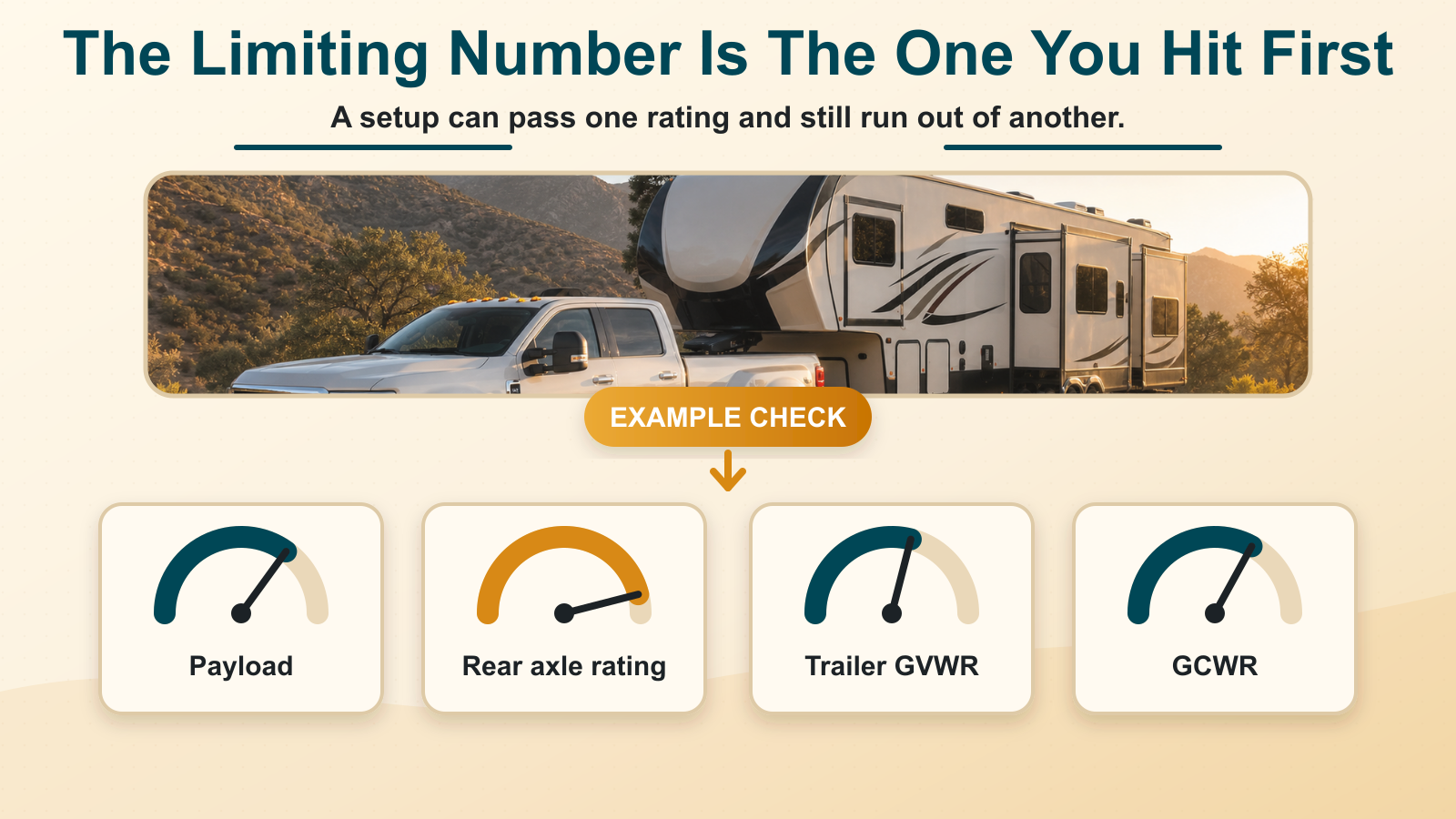
Say a truck has:
- GCWR: 30,000 lb
- GVWR: 11,500 lb
- Payload sticker: 3,200 lb
- RAWR: 7,000 lb
And the loaded truck and trailer together weigh 27,000 pounds. GCWR check passes. Easy.
Now look at what's sitting on the truck:
- Fifth wheel pin weight: 3,000 lb
- Fifth wheel hitch: 200 lb
- Driver and passenger: 350 lb
- Tools and bed gear: 250 lb
That's 3,800 pounds before we argue about anything else, and the payload sticker said 3,200. The combined weight is fine. The truck is over payload anyway.
That's the kind of math worth running before signing the paperwork on a new RV, not the weekend after you bring it home.
What Truck Upgrades Can and Cannot Change
This part comes up constantly, so I want to be straight about it.
There are real upgrades that can make a tow rig drive better. Helper springs, air springs, suspension upgrades, better shocks, properly rated tires, and the right hitch can all change ride quality, reduce squat, and improve how the rig feels going down the road. Those are real benefits. We've talked about a few of the truck upgrades we like on the channel.
What none of those products do is change the manufacturer's GVWR, GCWR, GAWR, RAWR, or payload rating. The door sticker is the door sticker.
That distinction matters because every once in a while, somebody shows up in the comments insisting their airbags raised their payload. They didn't. Airbags can level a squatting truck, which is a real and useful thing. They don't change what the axle, frame, brakes, tires, hitch, or factory certification say the truck is rated for.
If a truck is truly overloaded, the answer usually isn't more suspension. It's less weight, a lighter trailer, or a truck with more real payload.
When to Use a CAT Scale or Certified Scale
The calculator helps you plan. A scale is how you check your work.
CAT Scale's standard truck-and-trailer setup uses separate platforms for the steer axle, drive axle, and trailer axle group. That gives you axle weights and a total gross weight, which is exactly the information you want once the rig is loaded for camping.
Once you have a scale ticket, you can compare your front axle weight, rear axle weight, trailer axle weight, and combined weight against the ratings you already pulled in step two. If everything lines up, you're in good shape. If one of them is over, you've found your limiting number, and now you know what to fix.
We'll do a separate walk-through on weighing the rig, because that one really is its own article.
Final Takeaway
GVWR and GCWR aren't competing numbers and they aren't interchangeable. They answer different questions. GVWR tells you what one vehicle or trailer is rated to weigh. GCWR tells you what the truck and trailer are rated to weigh together. Both matter, both belong on the checklist, and neither one is enough on its own.
RV towing comes down to the whole picture: payload, axle ratings, tire ratings, trailer GVWR, hitch weight, GCWR, and what the scale actually says. The door sticker wins arguments. Brochures don't.
If you want the bigger picture on whether your truck and RV pencil out, start with the main towing pillar, and when you're ready to plug in your real numbers, run them through the calculator.
Run Your NumbersPractical Disclaimer
This article is educational. It's not a safety, legal, insurance, warranty, or manufacturer certification, and it isn't a substitute for one. Always verify your specific numbers using your truck's door sticker, owner's manual, manufacturer towing guide, RV weight labels, hitch and tire ratings, and actual scale weights. If your numbers are close or you're not sure how to read them, ask the vehicle manufacturer, the RV manufacturer, a qualified RV technician, or a towing professional before you head down the road.
FAQ
What is the difference between GVWR and GCWR?
GVWR is the maximum loaded weight of one vehicle or trailer on its own. GCWR is the maximum loaded weight of the truck and trailer together.
Is GVWR or GCWR more important for towing?
Both matter, and they answer different questions. GCWR checks the whole combination. GVWR checks each vehicle or trailer individually. For RVers, payload, rear axle rating, tire ratings, and trailer GVWR also need to be checked alongside both.
Can I tow safely if I am under GCWR?
Not automatically. You can be under GCWR and still be over payload, the rear axle rating, tire ratings, hitch rating, or trailer GVWR. GCWR is one check, not the whole answer.
Does GVWR include payload?
GVWR is the limit for the whole loaded vehicle. Payload is the portion of GVWR that's available for the stuff you add — passengers, cargo, hitch weight, and trailer tongue or pin weight. They're related, but they're not the same number.
Is trailer GVWR the same as actual trailer weight?
No. Trailer GVWR is the maximum loaded rating. Actual trailer weight is what it weighs when it's loaded for real life. If you don't have actual scale weights yet, trailer GVWR is a safer planning number than dry weight.
What is RAWR on a truck?
RAWR stands for Rear Axle Weight Rating — the maximum the rear axle is rated to carry. It matters a lot for fifth wheel setups because pin weight lands in the truck bed near the rear axle, and a fifth wheel can run a truck out of rear axle capacity before it runs out of GCWR.
Do airbags or helper springs increase GVWR or payload?
No. Airbags, helper springs, and suspension upgrades can improve ride height, reduce squat, and change how the truck feels under load. They do not change the manufacturer's GVWR, GCWR, GAWR, RAWR, or payload rating. The door sticker is still the door sticker.
How do I know if my truck and trailer are overweight?
Start with the truck door sticker, the truck manual, the RV weight label, and the LTNT payload calculator. Then verify with actual scale weights so you can compare your loaded truck, individual axles, trailer, and combined weight against the ratings.