Truck Payload vs Tow Rating: What RVers Need to Know Before Towing
Most RVers ask whether their truck can tow the camper. The better question is how much weight the RV puts on the truck. Here's how payload, tow rating, pin weight, door stickers, and CAT scale numbers actually work.
One of the biggest pieces of that math is fifth wheel pin weight — the loaded weight the front of the trailer puts directly into your truck bed. If that term is new or confusing, we break it down here: What Is Pin Weight on a Fifth Wheel? Hitch Weight Explained.
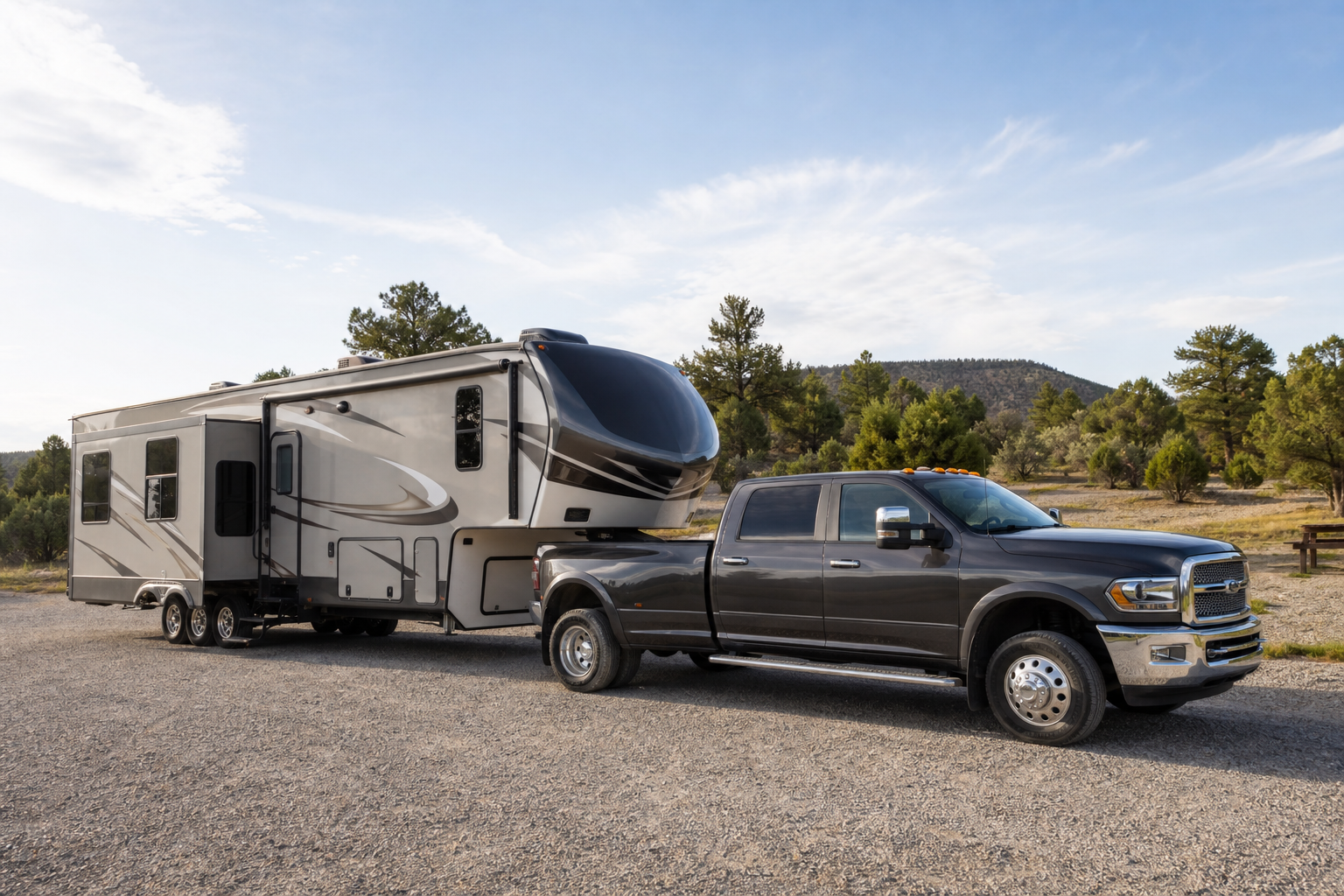
Walk into any RV dealership and you'll hear the same conversation play out a hundred times. "What does your truck tow?" "12,000 pounds." "You're good."
That's it. That's the whole safety check. Three sentences and a handshake, and now you're driving home with a 14,000-pound fifth wheel and a truck that's already over its limits before you put a single pair of socks in the bed.
Here's the thing nobody at that dealership wants to tell you: tow rating is not the number that matters most. I'll say it again because this is the part that ruins towing setups: tow rating is not the number that matters most.
The number that matters most is payload. And for most fifth wheel owners, payload runs out long before tow rating does.
This article is going to walk you through the actual math. The real numbers. The stuff your dealer probably didn't mention and your buddy at the campground definitely got wrong. Tow rating, payload, door stickers, tongue weight, pin weight, rear axle ratings, and how to verify the whole setup at a CAT scale.
Want to run your own setup?
Use our free truck payload calculator as you read. It will not replace your stickers, manuals, or scale tickets, but it can help you spot a problem before you spend real money.
Run Your NumbersThe calculator and the examples in here are estimates. Always verify your own door sticker payload, axle ratings, tire ratings, hitch ratings, and RV ratings before you tow anything.
The Wrong Question Almost Everyone Asks First
"Can my truck tow this camper?" That's the question. That's where almost every RV towing conversation starts. And it makes sense because tow rating is the big number on the brochure. It's the number salespeople love. It's the number your neighbor brags about.
But "can pull it down the road" and "is safe and legal when actually loaded for travel" are two completely different things.
Here's what most people miss: an RV doesn't just float behind your truck. A big chunk of its weight transfers onto the truck, and that weight counts against payload. Add your spouse, your dog, your hitch, your tools, your firewood, your generator, the cooler in the bed, and the bikes on the back, and your available payload disappears fast.
So forget the question "Can it tow it?" The real question is: How much weight is this RV putting on my truck?
Tow rating is what your truck can pull. Payload is what your truck can carry. For RV towing, you need both numbers to work. Not one. Both.
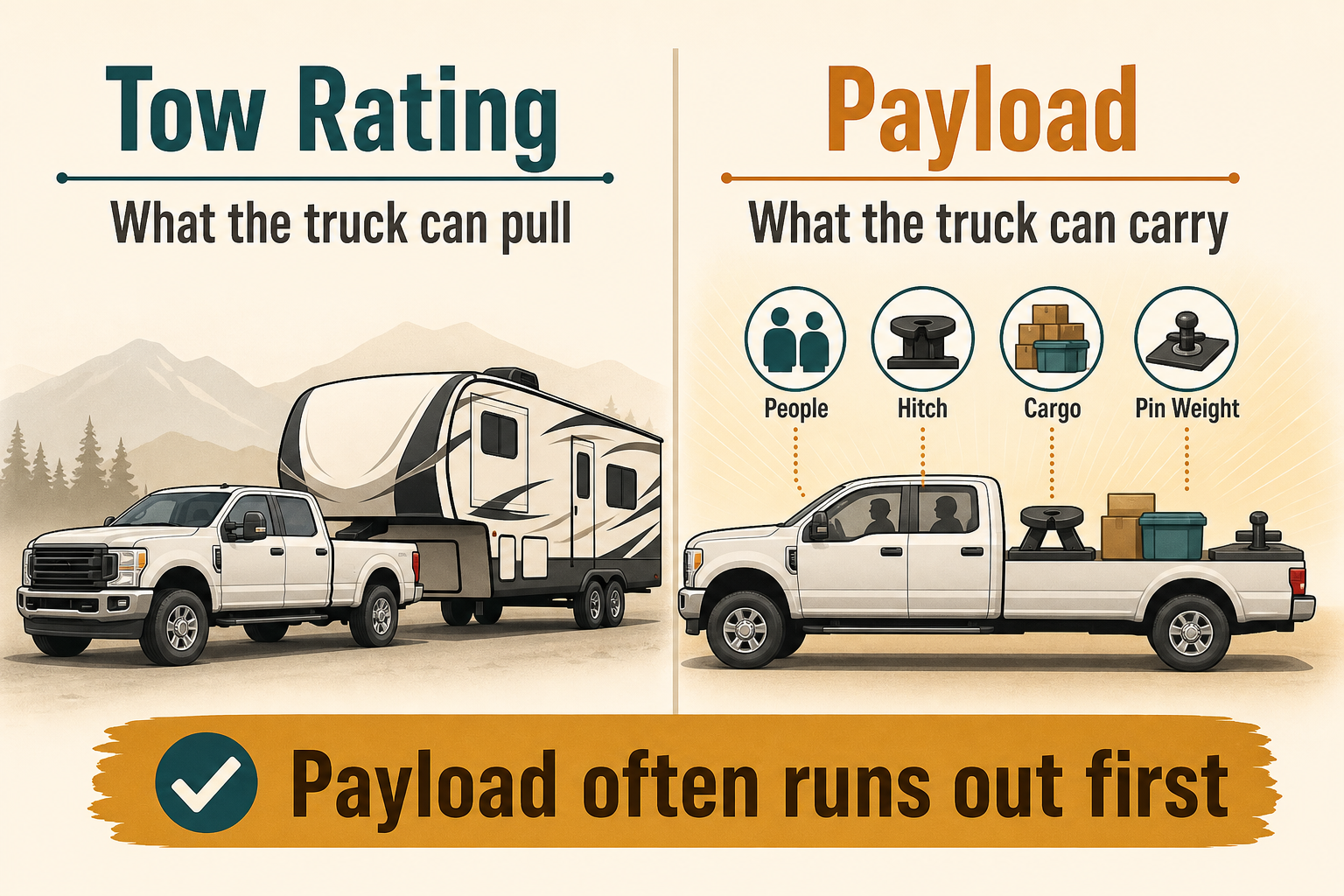
In the video, Darlene and I walk through the same math you're about to read here, including real-world examples of setups that look fine on tow rating but fall apart the moment you add payload, pin weight, hitch weight, people, and gear.
What Tow Rating Actually Means (And What It Doesn't)
Tow rating tells you the maximum trailer weight your truck is rated to pull under specific conditions. Sounds simple. It's not.
Tow ratings change based on engine, axle ratio, cab configuration, bed length, drivetrain, trim level, options, and tow package. Two trucks with the same badge can have wildly different ratings. Your buddy's "same truck" probably isn't actually the same truck.
But here's the bigger issue: tow rating doesn't tell you anything about how much weight is actually sitting on your truck. It doesn't account for your family, the hitch, your bed cargo, your aftermarket goodies, or the loaded tongue weight or pin weight of your RV.
That's why a truck can be under its tow rating and still be over its payload, rear axle rating, tire rating, or hitch rating. Tow rating matters. It's just not the whole story. And anyone who tells you otherwise is probably trying to sell you something.
What Payload Actually Means
Payload is what your truck can carry. Period.
That includes you, your passengers, your pets, your tools, your fuel cans, your firewood, your coolers, your bed cover, your truck topper, your aftermarket accessories, your RV hitch, your travel trailer tongue weight, your fifth wheel pin weight, and anything else riding in or on the truck.
Payload isn't just "stuff in the bed." It's everything that got added to the truck after it left the factory. This is the number that ambushes people.
A truck can have a huge tow rating and a surprisingly small payload rating. And with RVs, the loaded tongue weight or pin weight will eat a massive chunk of that payload before you've even buckled the dog into the back seat.
Where to Find Your Real Payload Number
Open your driver's door. Look for the yellow sticker. You're looking for the line that says something like: "The combined weight of occupants and cargo should never exceed..."
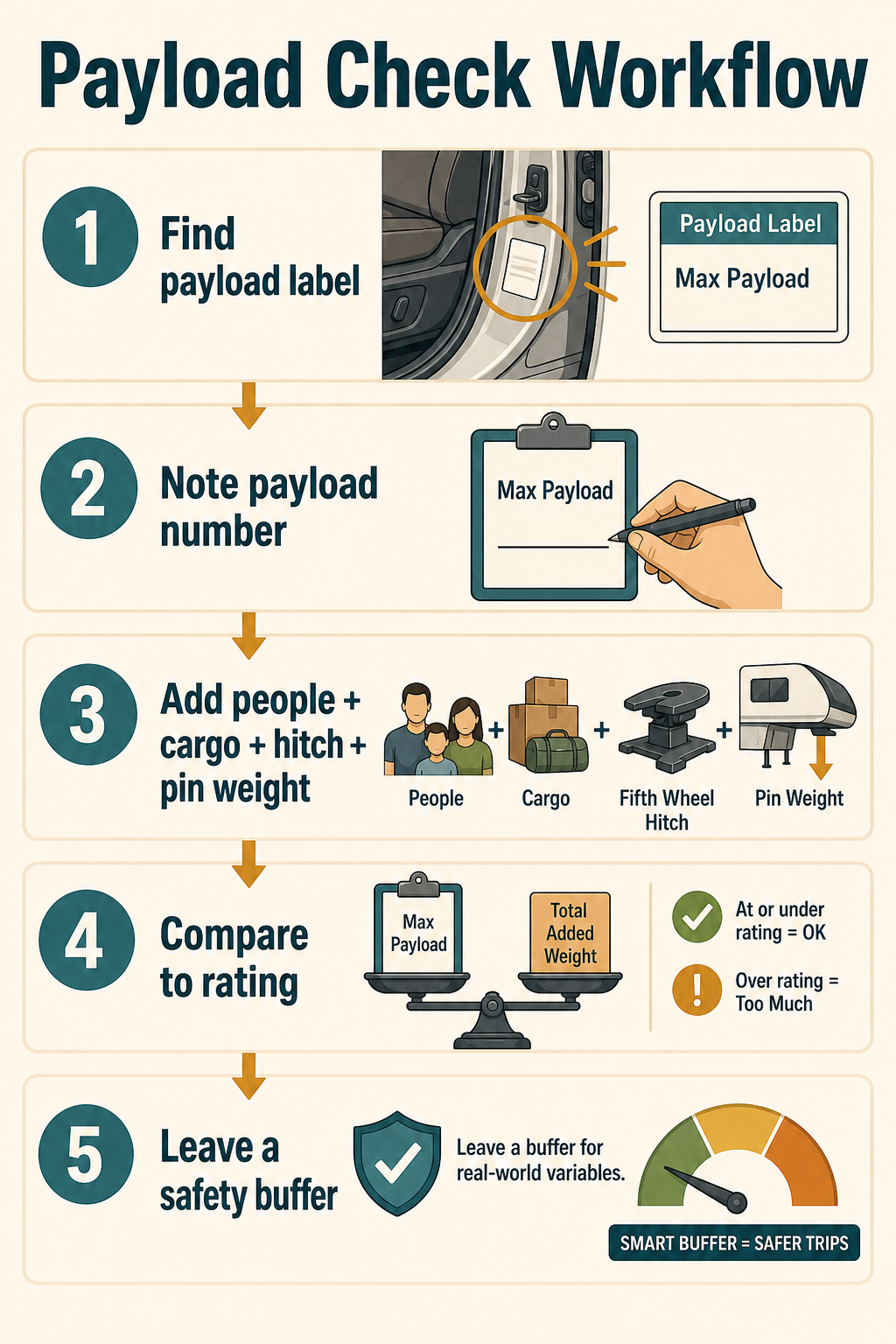
That number is your payload. Not the brochure number. Not the dealer's number. Not what a guy on a forum told you. That number, on your sticker, on your truck.
Why does this matter so much? Because online specs lie. Or rather, they generalize. A base regular cab truck can have way more payload than a loaded crew cab 4x4 with a diesel, sunroof, big wheels, and every option box checked.
Same model name. Same truck family. Totally different payload. When in doubt, the door sticker wins. Always.
Door Sticker Payload vs Rear Axle Rating
Payload is the first number you need to understand. It's not the only one.
Your truck also has axle ratings. They're listed on the certification label inside the door jamb, usually written as GAWR, which stands for gross axle weight rating. Plain English: GAWR is the maximum rated weight for each axle.
For RV towing, the rear axle is the one that gets stressed. That's where most of the trailer's tongue weight or pin weight ends up, especially with fifth wheels where the hitch sits in the bed and the pin weight lands directly over the rear axle.
Here's why this matters: a truck can be totally fine on total payload and still be overloaded on the rear axle. You won't know until you actually weigh the truck by axle. That's where a CAT scale earns its keep.
Travel Trailer Tongue Weight vs Fifth Wheel Pin Weight
These two trailer types load your truck very differently.
A travel trailer hooks up at the bumper through a hitch receiver. Tongue weight is usually around 10 to 15 percent of the loaded trailer weight. Most people use 13 percent as a working estimate when they don't have scale numbers yet.
So an 8,000-pound loaded travel trailer? Tongue weight is probably around 1,040 pounds. That 1,040 pounds is now on your truck. Counts against payload.
A fifth wheel is different. It hooks up in the truck bed, and pin weight is typically around 20 to 25 percent of the loaded trailer weight. Use 22 percent as a working estimate. And whatever you do, don't use the empty brochure pin weight. That number is fantasy.
So a 14,000-pound loaded fifth wheel? Pin weight is probably around 3,080 pounds. That 3,080 pounds is sitting on your truck. Counts against payload too.
For a deeper explanation of how fifth wheel pin weight works, why dry hitch weight is misleading, and how it eats into payload so quickly, read: What Is Pin Weight on a Fifth Wheel? Hitch Weight Explained.
This is where so many fifth wheel shoppers get blindsided. The truck has plenty of tow rating to pull the trailer. But it doesn't have the payload, or the rear axle capacity, to carry the pin weight, plus the hitch, plus the family, plus the gear. The trailer pulls fine. The truck is just overloaded the entire time.
Stop Using Dry Weight. Just Stop.
Dry weight is the empty factory weight of an RV. It's the weight before real life shows up.
Real life shows up with a lot of stuff: water, propane, batteries, solar, food, tools, clothes, camp chairs, hoses, bikes, kitchen gear, dog food, spare parts, and upgrades. Some of it goes in the RV. Some of it goes in the truck. All of it affects your towing setup.
Dry weight is too optimistic. It's a number that exists for marketing. It is not a number that exists for towing math.
If you don't know your actual loaded trailer weight yet, use the RV's GVWR, or gross vehicle weight rating. That's the maximum the RV is rated to weigh when loaded. Will you always tow at GVWR? Maybe not. But planning with GVWR keeps you from buying a trailer that only fits your truck on paper, when both are empty, in fantasy land.
Once you own the setup, weigh it loaded the way you actually travel. Not how you wish you traveled. How you actually do it.
A Real Payload Math Example
Let me show you what this looks like with real numbers. Start with the door sticker.
Travel Trailer Example
- Door sticker payload: 2,400 pounds
- Loaded travel trailer estimate: 8,000 pounds
- Estimated tongue weight at 13 percent: 1,040 pounds
- Weight distribution hitch: 100 pounds
- People and pets in truck: 450 pounds
- Tools and cargo in truck: 300 pounds
What the truck is carrying: 1,040 pounds of tongue weight, 100 pounds of hitch, 450 pounds of people and pets, and 300 pounds of truck cargo. Estimated payload used: 1,890 pounds.
With a 2,400-pound payload, this setup has about 510 pounds of estimated payload remaining. Not perfect, but in the ballpark. You still need to verify axle ratings, tire ratings, hitch ratings, trailer GVWR, and actual scale weights. But the first pass of the math works.
Fifth Wheel Example
- Door sticker payload: 3,100 pounds
- Loaded fifth wheel estimate: 14,000 pounds
- Estimated pin weight at 22 percent: 3,080 pounds
- Fifth wheel hitch: 180 pounds
- People and pets in truck: 400 pounds
- Bed cargo: 150 pounds
What the truck is carrying: 3,080 pounds of pin weight, 180 pounds of hitch, 400 pounds of people and pets, and 150 pounds of bed cargo. Estimated payload used: 3,810 pounds.
The payload rating? 3,100 pounds. That truck is 710 pounds over payload before anyone has loaded a single tool, filled a single fuel can, or strapped a single bike to the back. The tow rating might be totally fine. The payload is wrecked.
This is exactly why payload matters more than tow rating. Every. Single. Time.
Before you fall in love with a floorplan, run the numbers.
Use your own door sticker payload, realistic tongue or pin weight, hitch weight, passengers, pets, and cargo. The calculator will not make the final call for your setup, but it can help you catch a mismatch early.
Check Your Real-World Towing NumbersThe Most Common RV Towing Mistakes
Trusting Tow Rating and Ignoring Payload
This is the big one. The granddaddy of towing mistakes. A truck can be rated to pull the trailer and still not have enough capacity to carry the pin weight, the hitch, the people, and the gear. Tow rating gets the headlines. Payload decides whether the setup actually works.
Believing the Dealer Without Checking the Sticker
Some RV dealers are great. Some are not. Either way, it's your truck, your RV, your family, and your responsibility. Don't outsource your safety check. Open the door. Look at the sticker. Trust the sticker.
Assuming a Level Truck Is a Safe Truck
A level truck can absolutely be overloaded. Air springs, suspension upgrades, and weight distribution hitches all change how the rig sits and handles. They do not change the factory payload rating on your door sticker. A truck riding level is not the same thing as a truck within its ratings.
Thinking Airbags Add Payload
They don't. They never have. They never will. Airbags can level your truck and improve ride quality within the truck's ratings. That's it. They do not increase your payload rating, rear axle rating, tire rating, or GVWR.
If you bolt airbags onto an overloaded truck, you have a level overloaded truck. That's the only thing that changed.
Thinking a Weight Distribution Hitch Removes Weight From the Truck
A weight distribution hitch is a great tool for the right travel trailer setup. It distributes tongue weight across the truck and trailer axles, improves stability, and when it's matched and adjusted right, makes towing better.
What it does not do is erase tongue weight. It does not turn an overloaded truck into a within-limits truck. You still have to do the payload math. Every time.
Running the Numbers After You Buy
This is the painful one. It is so much easier to run numbers before you fall in love with a floorplan than after the RV is parked at your house.
Photograph the door sticker. Find the GVWR. Estimate tongue or pin weight. Add the hitch. Add the people. Add the cargo. See where you land. Do it before you sign anything. Future you will thank present you.
Where etrailer Fits Into All of This
Some links in this article are affiliate or sponsor links, meaning we may earn a commission if you buy through them at no extra cost to you. We only include products and resources that actually fit the topic.
Towing gear matters. But it should support the right setup. It should never be used to justify the wrong one.
A resource like etrailer is one of the better ones. They carry RV and towing parts like fifth wheel hitches, weight distribution hitches, brake controllers, suspension support, and towing accessories. Their fit information helps you find parts that actually match your specific truck and RV.
But here's the order that matters: numbers first, parts second. A properly matched fifth wheel hitch still has to fit within your payload and axle ratings. A weight distribution hitch still needs to be set up right and matched to your loaded tongue weight. Air springs help with leveling and ride feel. They don't add payload.
Know your numbers. Then shop for the right parts. Not the other way around.
How to Weigh Your Setup at a CAT Scale
Estimates are great for planning. Scale numbers are how you check reality. A CAT scale or other certified scale shows you exactly what your truck and RV weigh when they're loaded for actual travel.
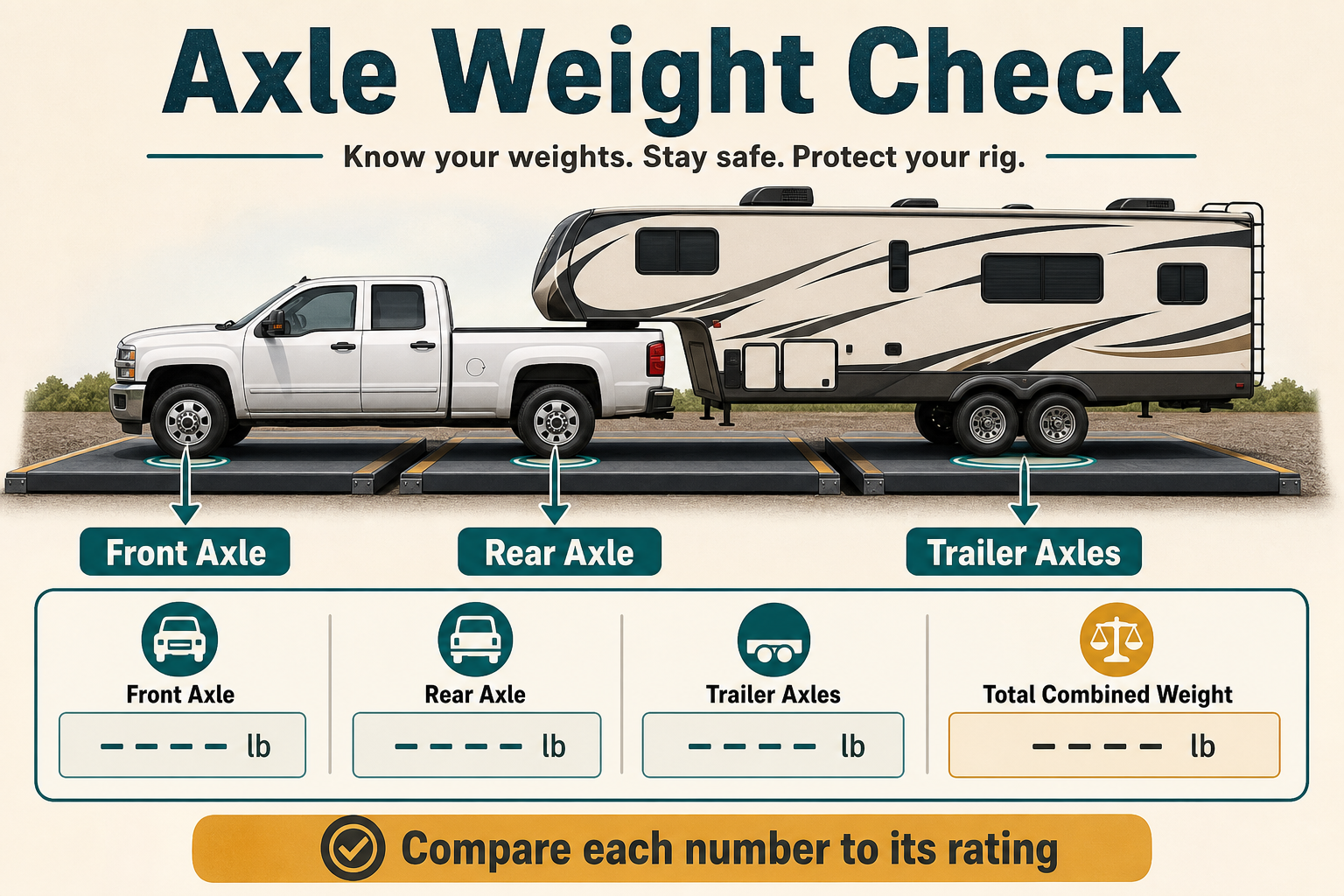
Here's the simple approach:
- Weigh the loaded truck by itself.
- Weigh the loaded truck and trailer together.
- Capture front axle weight, rear axle weight, and total weight.
- Compare every number to your truck's ratings.
- Compare the trailer weight to the RV's GVWR.
- Re-weigh after major changes.
What counts as a major change? Adding batteries. Adding solar. Adding a generator. Adding tools. Adding a truck topper. Adding cargo racks. Adding a new hitch. Carrying full water. Loading the rig differently than you used to.
If you tow a travel trailer, scale tickets help you check loaded tongue weight and your weight distribution hitch setup. If you tow a fifth wheel, scale tickets are even more important. Rear axle weight and pin weight are the two numbers that get fifth wheel owners in trouble, and a scale ticket is the only way to know for sure.
The point isn't to make this complicated. The point is to stop guessing.
Why Payload Matters for Safety
Here's the part nobody likes to talk about. An overloaded truck feels fine on a calm day on a flat road. It feels fine right up until the moment it doesn't.
Hard braking. A fast lane change. Crosswinds on a bridge. A steep downhill. A blown tire. A rough road. An emergency maneuver to avoid the deer that ran into the road. That's when payload starts mattering. And by then, it's too late to recheck the sticker.
Payload affects suspension, tires, steering, braking, stability, and control. Rear axle weight matters because that's where most of the RV weight ends up. Tire ratings matter because tires are the only thing connecting your rig to the road.
This isn't about scaring people into buying more truck than they need. It's about being honest with the numbers before the numbers matter. And let's be real about liability and insurance for a second. Rules vary by situation, claims vary by adjuster, lawsuits vary by state. The cleanest way to stay out of all of it is to stay within your ratings and verify your loaded weights. That's it.
Gas vs Diesel: Helpful, But Not a Payload Shortcut
Diesel trucks are wonderful for towing. More torque. Better engine braking. A more relaxed feel with heavy trailers.
But here's what gets missed: a diesel engine weighs more than a gas engine. That extra weight comes straight out of payload. This is why some gas trucks have more payload than the same model with a diesel. Same chassis. Same family. Different payload.
If you're shopping for a truck, don't assume diesel is automatically the right answer. Compare the actual payload stickers on the actual trucks you're considering. Not the engine badge. The sticker.
The door sticker still wins. It always wins.
What to Do Before You Buy or Upgrade
Before you spend a dollar on a truck, RV, or hitch, slow down. Gather the numbers. Get them right.
- Photograph the truck's yellow payload sticker.
- Find the truck's front and rear axle ratings.
- Check the truck's tire ratings.
- Check the hitch rating.
- Find the RV's GVWR.
- Estimate loaded tongue weight or pin weight.
- Add the hitch weight.
- Add people, pets, cargo, and bed gear.
- Compare the total to the truck's payload rating.
- Verify the final loaded setup at a certified scale.
Travel trailer shopping? Use a realistic loaded tongue weight estimate. Not the brochure dry tongue weight. Fifth wheel shopping? Pay extra attention to pin weight and rear axle rating. Fifth wheels get heavy on the truck faster than people expect. Way faster.
Want a starting point?
Run your numbers through the calculator. It will not replace your stickers, your manuals, or your scale tickets. But it will help you spot a problem before you spend real money.
Use the Free Truck Payload CalculatorThe Calm Way to Think About Towing Numbers
Towing conversations get emotional fast. I get it. People are proud of their trucks. Dealers want to sell RVs. Forums turn into shouting matches. And nobody wants to hear that the floorplan they fell in love with doesn't match the truck sitting in their driveway.
But the math doesn't care about any of that. Your truck has ratings. Your RV has ratings. Your loaded setup has real, measurable weights. Your only job is to make those numbers line up.
Start with the door sticker. Use realistic loaded trailer weight. Estimate tongue or pin weight. Add what the truck carries. Check the rear axle and tires. Then weigh the rig loaded for travel.
Do that, and you'll dodge most of the towing trouble out there.
Towing Safety Disclaimer
This article is for general RV towing education only. It is not legal, engineering, insurance, or manufacturer-specific towing advice. Always verify your own truck, tire, hitch, axle, and RV ratings using the actual labels and manuals for your equipment, and confirm your real loaded weights at a CAT scale or other certified scale. Do not rely on brochure numbers, dealer estimates, online charts, this calculator, or this article as the final determination of whether your setup is safe, legal, or appropriate for your situation.
FAQ
What is the difference between tow rating and payload?
Tow rating is how much weight your truck is rated to pull. Payload is how much weight your truck is rated to carry. For RV towing, payload includes people, pets, cargo, hitch weight, and the trailer's tongue weight or pin weight.
Why does payload matter when towing an RV?
Because part of the RV's weight ends up sitting on the truck. A travel trailer puts tongue weight at the hitch. A fifth wheel puts pin weight in the bed. Either way, that weight counts against your truck's payload rating.
Where do I find my truck's payload rating?
Open the driver's door and find the yellow tire and loading information sticker. Look for the line that says, "The combined weight of occupants and cargo should never exceed..." That number is specific to your truck as it was built. Trust it over any brochure or online spec.
Can my truck be under tow rating but over payload?
Yes. This happens all the time with RVs. The truck has plenty of tow rating to pull the trailer but not enough payload to carry the tongue weight or pin weight plus passengers, hitch, and cargo.
How much tongue weight does a travel trailer put on a truck?
Plan for about 10 to 15 percent of the loaded trailer weight. Many people use 13 percent as a working starting point. Real numbers depend on the trailer and how it's loaded.
How much pin weight does a fifth wheel put on a truck?
Plan for about 20 to 25 percent of the loaded fifth wheel weight. Around 22 percent is a useful starting point. Verify with actual scale weights when you can.
Should I use dry weight or GVWR for towing math?
Use GVWR. Dry weight is too optimistic for real-world towing because it doesn't include water, propane, batteries, food, tools, or any of the upgrades that show up over time. GVWR is the safer planning number.
Do airbags increase truck payload?
No. Airbags can help with leveling and ride feel, but they do not change the manufacturer's payload rating, GVWR, rear axle rating, tire rating, or hitch rating.
Does a weight distribution hitch increase payload?
No. A weight distribution hitch can help spread tongue weight and improve handling when it's matched and adjusted properly, but it does not increase your truck's official payload rating.
What is rear GAWR?
Rear GAWR is the gross axle weight rating for the rear axle, which is the maximum rated weight that axle can carry. This matters a lot for RV towing because tongue weight and pin weight load up the rear axle fast.
How do I weigh my RV at a CAT scale?
Weigh the loaded truck by itself, then weigh the loaded truck and trailer together. Use the tickets to compare front axle, rear axle, and total weights against your truck and RV ratings.
How often should I re-weigh my truck and RV?
Re-weigh after any major change: adding batteries, solar, a generator, a topper, new hitch equipment, more tools, different cargo, or a different water load. Also re-weigh whenever you change trucks or RVs.
Final Thought
The best towing setup isn't the one that wins an argument online. It's the one that works on paper, works on the scale, and feels controlled when it actually counts.
Start with the door sticker. Respect the payload. Check the rear axle. Use real loaded weights. And if you're still in shopping mode, please run the numbers before the floorplan steals your heart.
Your truck, your RV, your family. Your numbers.
Check Your Real-World Towing Numbers