Fifth Wheel Pin Weight and Hitch Weight Explained
There's one number that will quietly sink your fifth wheel purchase, and almost nobody at the dealership wants to talk about it.
Pin weight.
You'll see it called hitch weight, dry hitch weight, king pin weight, or fifth wheel hitch weight depending on whose spec sheet you're reading. Different names, same number. And it matters more than tow rating, more than the badge on the side of your truck, and more than whatever the sales guy is telling you on the lot.
Here's why. The second that fifth wheel hitches up, pin weight stops being a trailer number. It becomes a truck number. It eats your payload. It loads your rear axle. It pushes against your tire ratings, your wheel ratings, and your hitch rating. So when someone tells you, "That truck can tow 18,000 pounds," they may be technically right and still completely wrong about whether the setup works.
A fifth wheel doesn't just get pulled. It gets carried.
Want to run your own numbers?
If you already have your truck's payload sticker and your fifth wheel numbers, run them through the LTNT payload calculator. It won't certify your setup as safe or legal — nothing online can. But it's a better next step than trusting a brochure.
Run Your NumbersWatch: The Towing Number Most RVers Miss
Before we go deeper on pin weight, this video covers the bigger mistake — looking at tow rating and missing payload entirely.
What Is Pin Weight on a Fifth Wheel?
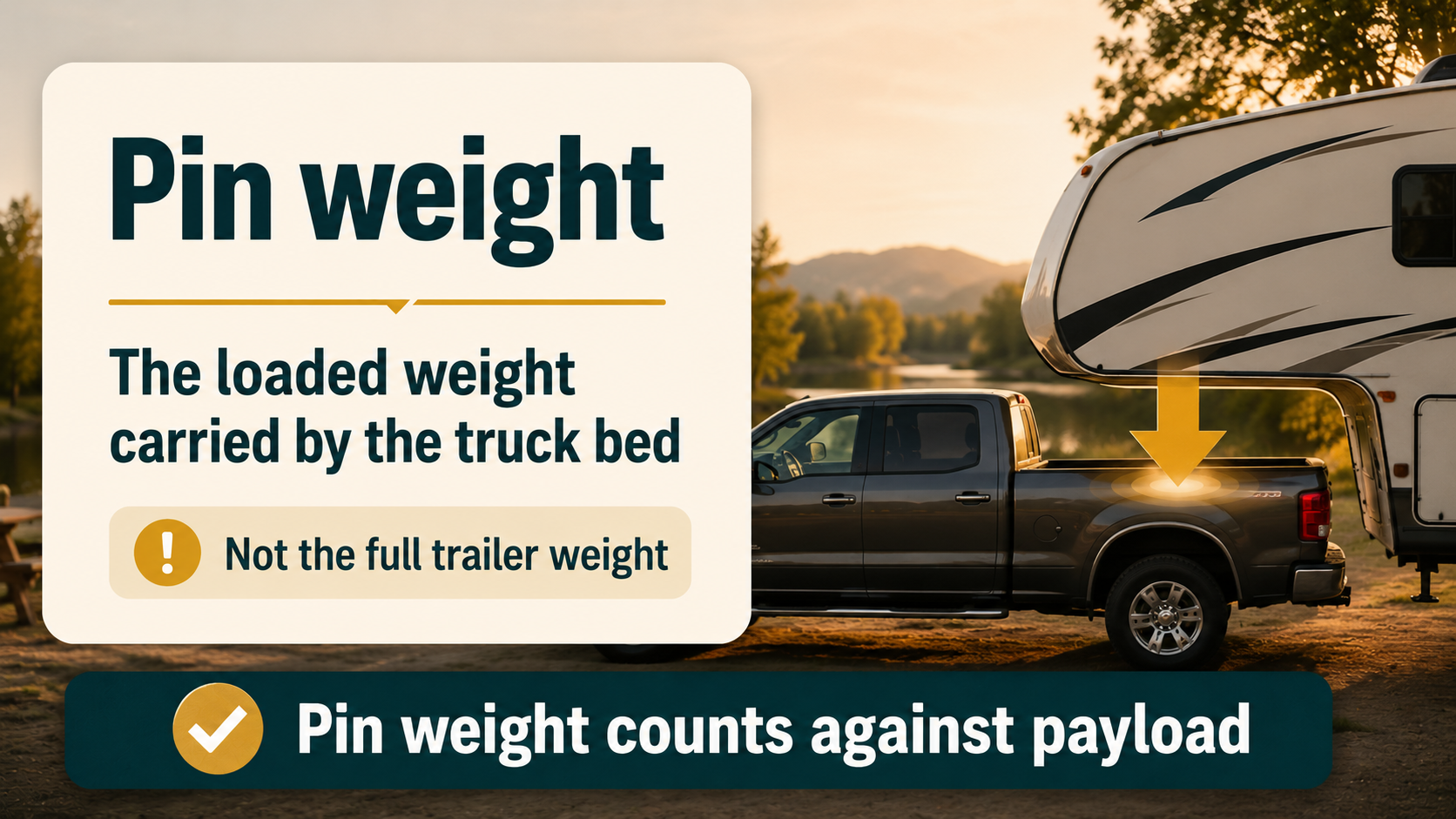
Pin weight is the downward weight from the front of the fifth wheel that sits in the bed of your truck through the hitch. That's it. It's the chunk of the trailer your truck is carrying.
The trailer axles do most of the work — they carry the bulk of the trailer's weight. But a fifth wheel is designed so a meaningful slice of the trailer sits over the truck, and that's part of what makes fifth wheels tow so well. It's also why payload runs out faster than people expect.
Pin weight is not total trailer weight. A 14,000-pound fifth wheel isn't putting 14,000 pounds in your truck bed. Some of it rides on the trailer axles, some of it rides on your truck. The truck-bed portion is what we're talking about here, because that's the portion competing with your payload sticker.
Pin Weight vs Hitch Weight: What's the Difference?
For fifth wheels, pin weight and hitch weight mean the same thing in practice: the weight the trailer puts down through the hitch in your truck bed. Manufacturers use different terminology — pin weight, hitch weight, dry hitch weight, king pin weight, fifth wheel hitch weight — but they're all pointing at the same load on the same axle.
Context tells you what the spec sheet means. If the number describes downward weight at the front of a fifth wheel, that weight is going in your truck bed. Period.
Travel trailer tongue weight is a related concept, but it's a different setup. A travel trailer hangs its weight off a hitch behind the truck. A fifth wheel drops its weight into the truck bed, usually over the rear axle. Both count against payload. They just load the truck in different places.
Dry Pin Weight vs Loaded Pin Weight
The pin weight on the brochure is almost always a dry number. Useful for shopping. Useless for deciding.
Nobody camps dry. Once you add food, clothes, tools, water hoses, sewer gear, bedding, batteries, propane, outdoor chairs, kitchen stuff, spare parts, and the eighteen other things that turn out to be "essential" once you actually live in the rig, the weight changes. If you full-time, boondock, carry tools, run a washer-dryer, or load up that big front pass-through storage, it changes a lot.
And here's the part most shoppers miss: where you load matters as much as how much you load. Most fifth wheels have major storage forward of the trailer axles. Weight loaded up front doesn't add to pin weight one-for-one — it adds more. Every pound forward of the axles pushes a bigger share of the trailer's weight onto the truck.
Dry pin weight is a starting point. It is not the answer.
How Pin Weight Affects Truck Payload
Payload is what the truck can carry. Pin weight uses payload. That's the whole conversation in two sentences.
Your truck's payload number has to cover everything riding on the truck:
- Driver and passengers
- Pets
- The fifth wheel hitch itself
- Tools and cargo in the cab or bed
- Fuel and accessories
- Loaded pin weight
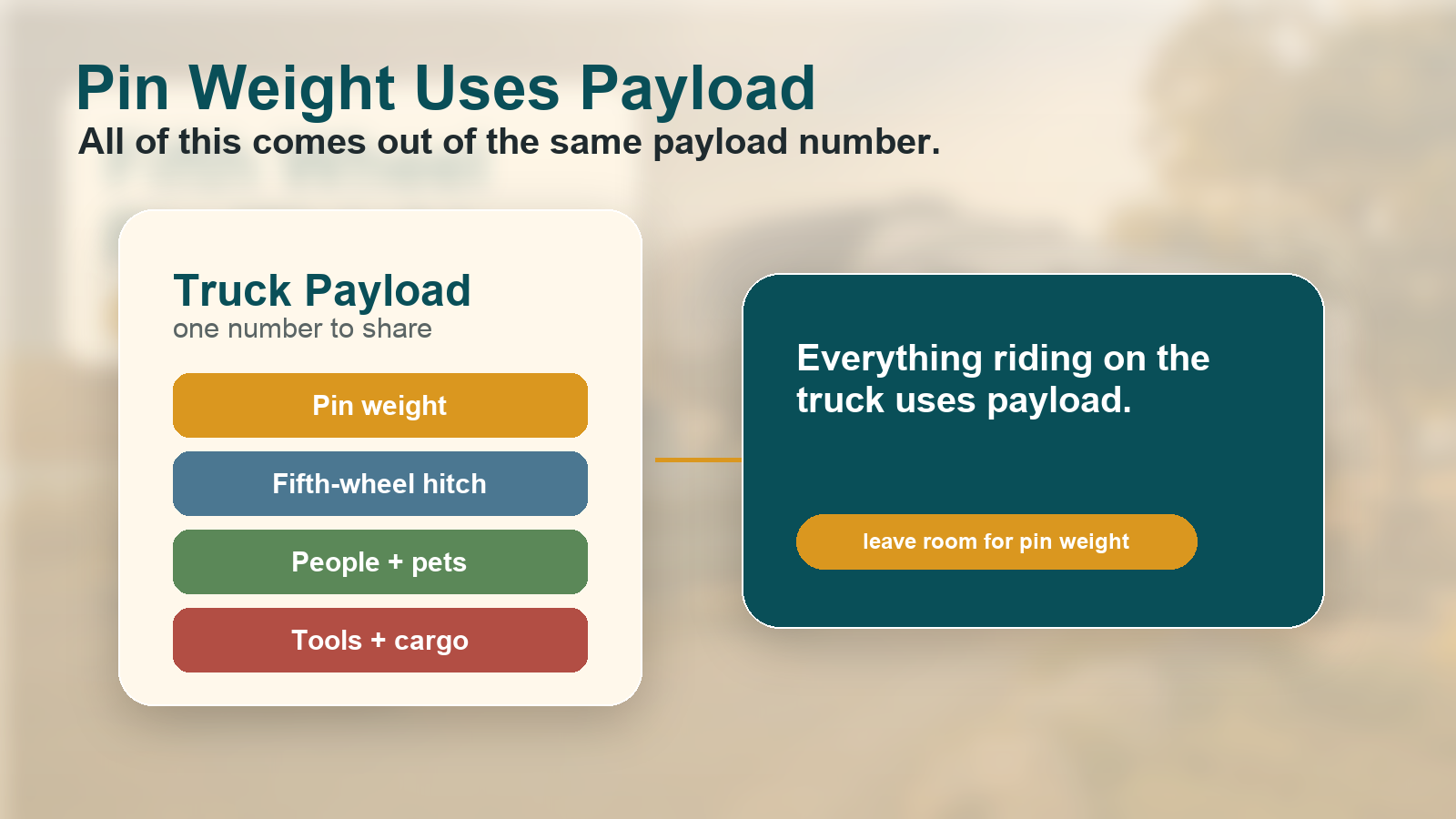
This is where the math breaks for most fifth wheel shoppers. The tow rating looks enormous. The payload sticker tells a very different story. A 3,200-pound payload sounds like plenty until you start subtracting the hitch, the people, the pets, the tools, and the bed cargo. Whatever's left over is what you actually have for pin weight.
Fifth wheels run out of payload before they run out of tow rating. Almost every time.
This is exactly the math the LTNT payload calculator was built for. For the broader "can my truck tow this fifth wheel?" question, read the main guide: Can My Truck Tow My Fifth Wheel?
How Pin Weight Affects the Rear Axle
Pin weight isn't an abstract number on a payload sticker. It's a physical force landing in your truck bed, usually right over the rear axle. So the rear axle weight rating matters on its own — separate from payload, separate from tow rating.
A truck can pass the tow rating check and still be too heavy on the rear axle once everything's hitched. Stack the fifth wheel hitch, the bed cargo, an auxiliary fuel tank, or a generator behind the cab and you've added rear axle load before the trailer even shows up.
"Can it tow X pounds?" is the wrong question. The right questions are:
- What's the payload?
- What's the rear axle rated to carry?
- What are the tires and wheels rated to carry?
- What's the hitch rated for?
- What does the loaded rig actually weigh on a scale?
That's the full picture. For the deeper breakdown on GVWR, GCWR, GAWR, and RAWR, we covered it here: GVWR vs GCWR: What RVers Need to Know Before Towing.
How Much Pin Weight Is Too Much?
Too much is the moment it pushes your truck over any rating — payload, rear axle, tire, wheel, or hitch. There's no universal safe number. The limit is whatever rating runs out first on your specific truck.
As a planning range, loaded fifth wheel pin weight tends to land somewhere around 15–25% of loaded trailer weight. That's a rough estimate, not a rule. Some rigs land outside it depending on floor plan, storage layout, and how you load. But it's a useful sanity check while shopping, because it stops you from treating a dry brochure number as your real-world pin weight.
A 14,000-pound fifth wheel at 20% means roughly 2,800 pounds of pin weight. Your trailer might come in lower. It might come in higher. What it won't do is match the dry number on the brochure.
Plan with margin. Verify with a scale when you can.
A Worked Example: How Pin Weight Can Overload a Truck
Round numbers. Truck has:
- Payload sticker: 3,200 lb
- Fifth wheel hitch: 200 lb
- Driver, passenger, pets: 450 lb
- Tools and bed cargo: 250 lb
Before the fifth wheel is even hitched, the truck has used 900 pounds of payload on the hitch, people, pets, and bed cargo. That leaves 2,300 pounds for pin weight.
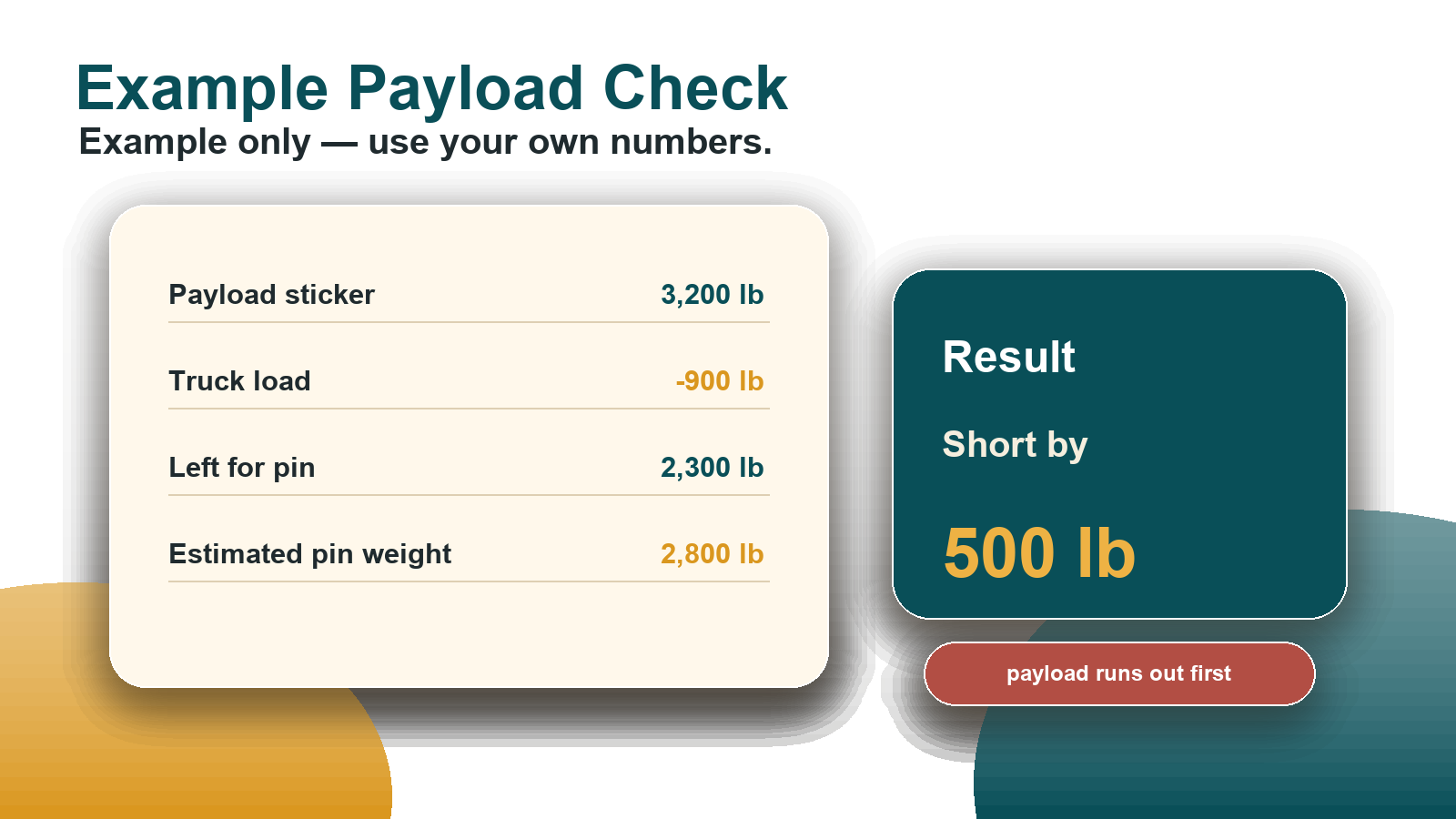
The fifth wheel weighs 14,000 pounds loaded. At a 20% pin weight estimate, that's 2,800 pounds.
Available: 2,300. Needed: 2,800. Short by 500.
And that's before we look at the rear axle rating, tire ratings, hitch rating, or what the CAT Scale would actually say about the rig.
Here's the part that catches people: this same truck and trailer combination still looks fine against the brochure tow rating. The truck "can tow" the trailer. It just can't legally carry it.
Tow rating answers one question. Payload answers a different one. The limiting number is the one you hit first — and on a fifth wheel, that's almost always payload.
How to Estimate Pin Weight Before You Buy
If you're shopping and you don't have scale numbers yet, you can still get close.
Start with trailer GVWR, not dry weight. GVWR assumes the trailer could be loaded all the way to its rating, which is the conservative planning number when you don't know exactly what you'll pack. Then apply a realistic pin weight percentage — that 15–25% range is a reasonable starting point.
Then stack up the truck-side load: hitch, people, pets, tools, bed cargo, accessories. Compare the total to your truck's payload sticker.
If the math only works under perfect assumptions — empty truck, dry pin weight, no margin — that's not a setup I'd buy. It's a lot easier to walk away from a sales floor than to walk away from a fifth wheel that's already in your driveway.
How to Measure Pin Weight in Real Life
Estimating is for planning. Measuring is for knowing.
Some RVers use a dedicated fifth wheel pin weight scale, which works if you have access to one and know how to use it. Most people verify the bigger picture with a certified scale instead. The basic idea: weigh the truck's axles before and after hitching the fifth wheel, then compare the difference to the truck's ratings.
This isn't a CAT Scale tutorial — that deserves its own article and we'll cover it separately. For this one, the point is simple. Real scale numbers tell you what's actually on the truck, especially on the rear axle. Planning math gets you close. The scale tells you the truth.
Common Mistakes With Fifth Wheel Hitch Weight
Trusting dry hitch weight as if it's loaded pin weight. The number on the spec page is the trailer empty. Your trailer isn't going to be empty. Load it for a trip — especially forward of the axles — and pin weight climbs.
Forgetting the hitch itself. The fifth wheel hitch lives in your truck bed and uses payload before the trailer is even connected. A couple hundred pounds you'll never see on a trailer spec sheet, because it isn't a trailer number.
Forgetting normal truck cargo. Tools, air compressor, generator, firewood, extra fuel, bed cover, toolbox, camping gear, pet supplies. Individually, none of it seems like much. Together, it's competing with pin weight for the same payload number.
Looking only at max tow rating. Max tow rating answers what the truck can pull under manufacturer test conditions. Pin weight asks what the truck can carry in real life. Different questions, different answers, and only one of them keeps your setup inside its ratings.
What to Do If Your Pin Weight Is Too High
Re-check the numbers first.
Use your actual payload sticker, not a generic figure from a forum. Include the hitch, the people, the pets, the tools, the bed cargo, and a realistic loaded pin weight estimate — not the dry brochure number.
If you already own the rig, get to a scale when you can. A scale ticket beats every spreadsheet you'll ever build.
If the numbers are still over, the answer isn't to hope the extra weight disappears. You may be able to reduce cargo, travel with less water, or redistribute items toward the rear of the trailer. Be careful — moving weight around changes how the rig tows, and reducing cargo only helps if it's realistic for how you actually camp.
Suspension helpers, airbags, and similar upgrades may improve ride height and reduce squat. They don't change the manufacturer's payload rating on the door sticker. They never have.
If the setup truly doesn't work, the honest options are a lighter fifth wheel, a different floor plan, less truck cargo, or a more capable truck. None of those are the answer anyone wants. All of them are better than finding out the hard way.
Final Takeaway
Fifth wheel pin weight is the weight your truck has to carry from the front of the trailer. Pin weight, hitch weight, dry hitch weight, king pin weight — different terms, same number. The question underneath all of them is the same one:
How much loaded weight is landing in your truck bed?
That number uses payload. It loads the rear axle. It can overload a truck that "can tow" the trailer just fine.
So don't stop at "can it pull it?" Ask whether the truck can carry the loaded pin weight, hitch, people, pets, tools, and cargo while staying inside every one of its ratings.
Before you sign paperwork on a fifth wheel — or before you hitch up the one you already own — run your real numbers through the LTNT payload calculator. Ten minutes now beats a tough conversation later.
Run Your NumbersPractical Disclaimer
One last note: we're sharing what we've learned from our own rig and our own research. Weights and ratings vary by truck, trailer, hitch, and how the RV is loaded. Verify your own numbers, check your door sticker, and use certified scale weights when you're making real towing decisions.
FAQ
What is pin weight on a fifth wheel?
Pin weight is the downward weight from the front of a fifth wheel that sits in your truck bed through the hitch. It's the portion of the trailer's total weight your truck is carrying.
Is fifth wheel pin weight the same as hitch weight?
In most fifth wheel spec sheets, yes. Pin weight, hitch weight, dry hitch weight, and king pin weight all describe the same practical thing — the load the fifth wheel puts into your truck bed.
What is dry pin weight?
Dry pin weight is the pin weight before the RV is loaded with real-life cargo — water, propane, batteries, food, clothes, tools, and travel gear. Useful for shopping. Not a number to make a final decision on.
How much pin weight is too much?
Pin weight is too much the moment it pushes the truck over payload, rear axle rating, tire rating, wheel rating, or hitch rating. There's no universal safe number.
What percentage of fifth wheel weight is pin weight?
Loaded pin weight typically lands somewhere around 15–25% of loaded trailer weight. That's a planning range, not a promise. The actual percentage depends on trailer design and how the RV is loaded.
Does pin weight count against payload?
Yes. Fifth wheel pin weight counts against your truck's payload, along with the hitch, passengers, pets, tools, cargo, and everything else the truck is carrying.
Does the fifth wheel hitch count against payload?
Yes. The hitch itself uses payload the moment it's installed — before the trailer is even connected.
Can a truck be under tow rating but over payload?
Yes, and on fifth wheels it's the most common towing problem there is. A truck can be rated to pull the trailer's weight and still not have enough payload to legally carry the pin weight, hitch, people, and cargo.
Can airbags or helper springs increase payload?
No. Airbags, helper springs, and suspension upgrades can improve ride quality and reduce squat. They do not change the manufacturer's payload rating on the door sticker.
How do I measure fifth wheel pin weight?
You can estimate during shopping, but real verification means weighing the loaded setup. Some RVers use a dedicated fifth wheel pin weight scale. Most check truck axle weights and payload use with certified scale weights at a CAT Scale.